Why We Illustrate Kids Instead of Making AI Photos
A realistic AI photo of your child is hard to take back once shared. Why Magic Story draws kids as storybook heroes, and what to ask any AI app first.

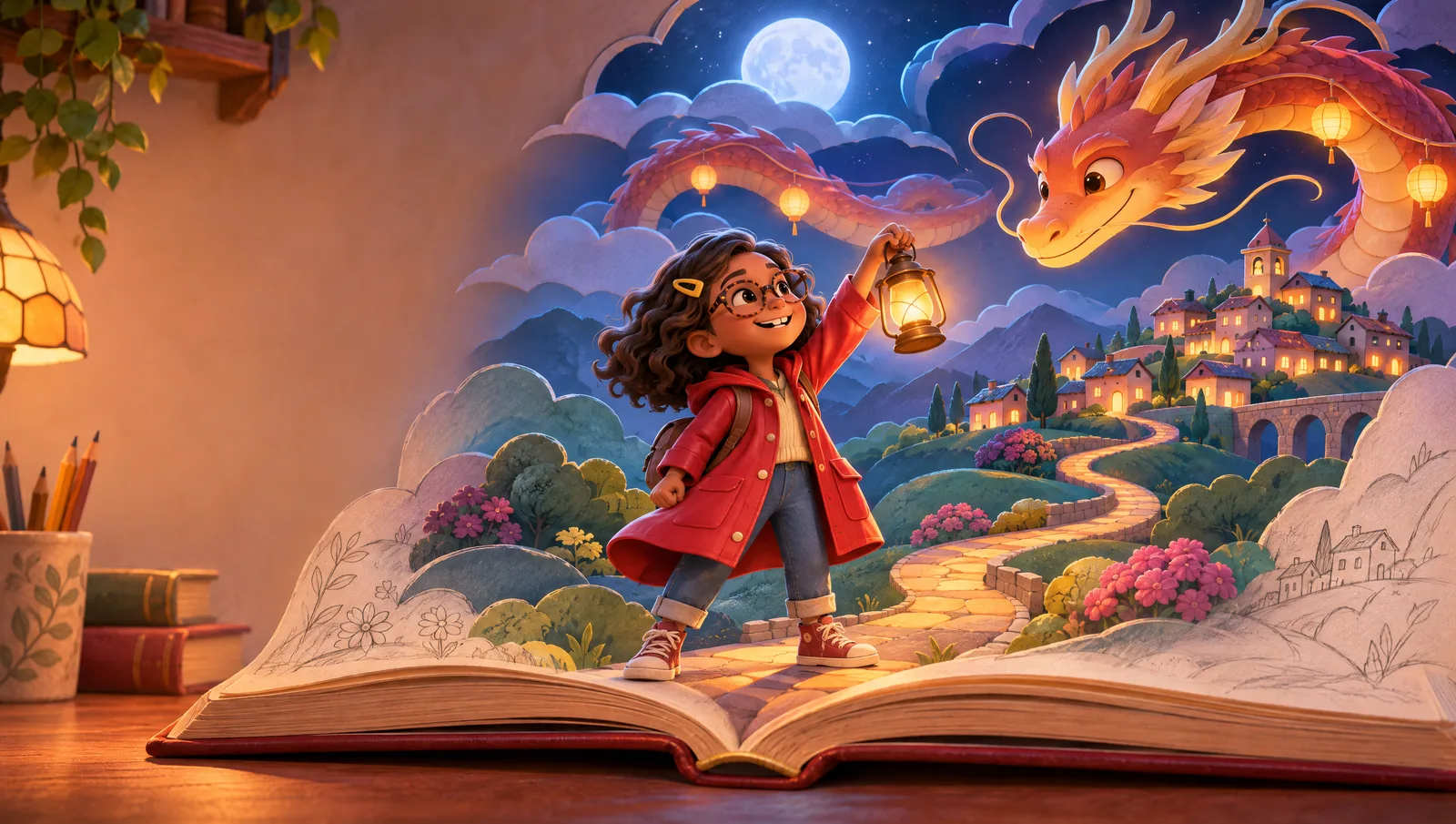
In this article
- 1. A fake photo of your child is a liability, not a keepsake
- Realistic images are hard to take back
- The law already treats your child's face as sensitive
- What Magic Story does with your photo
- Ask before you upload: a parent's checklist
- 2. Kids connect with pictures, and with themselves in them
- 3. The sweet spot: unmistakably your kid, unmistakably a storybook
- Unmistakably your kid
- Unmistakably a storybook
- The idea we built on
- Made like a keepsake
Upload a photo of your child. Get back a "photo" of them as an astronaut, a knight, a mermaid. It looks real. It isn't.
That technology exists, and it gets more convincing every month. We work with image models every day, and we decided not to point photorealism at your kid.
Every personalized Magic Story book draws your child as the hero of a fully illustrated world, printed as a keepsake made for one child. Not a photo. Not a fake photo. A drawing that is unmistakably them.
Here's why: safety, what kids respond to, and what likeness should really mean.
1. A fake photo of your child is a liability, not a keepsake
Realistic images are hard to take back
In June 2023 the FBI warned that malicious actors take ordinary photos, "typically captured from an individual's social media account," and turn them into explicit fakes that "appear true-to-life in likeness to a victim." Victims have included minors, and once that content circulates it can be "extremely difficult, if not impossible, to remove." In March 2024 the FBI added that child sexual abuse material made with generative AI is illegal under federal law, "including realistic computer-generated images."
We're not saying every company that makes realistic images is doing something wrong. We're saying a photoreal image of your child is, by design, a picture that could pass for a real photo of them. No picture online is risk-free, but if a picture of your kid ends up somewhere you never expected, we'd rather it be obviously a drawing.
The law already treats your child's face as sensitive
| Law | What it covers | Why it matters to parents |
|---|---|---|
| COPPA (US, FTC rule) | "A photograph, video, or audio file where such file contains a child's image or voice" counts as personal information. A 2025 update added biometric identifiers such as facial templates and faceprints, with full compliance due April 22, 2026. | Covered services generally need verifiable parental consent before collecting personal information from children under 13. |
| BIPA (Illinois) | A photo alone isn't a "biometric identifier," but a "scan of hand or face geometry" is. | Collecting one requires written notice, a signed release and a public retention and destruction policy. People can sue for $1,000 per negligent violation and $5,000 per intentional or reckless one. |
| CUBI (Texas) | A "record of hand or face geometry" captured for a commercial purpose. | It needs notice and consent first, and generally must be destroyed within a year after its purpose ends. The attorney general can seek up to $25,000 per violation. |
| GDPR (EU) | Biometric data used to uniquely identify someone is a special category, which can't be processed without an exception such as explicit consent. | When an online service offered directly to children relies on consent, kids under 16 need a parent's (countries may lower that age to 13). |
| Children's Code (UK, ICO) | 15 standards for online services children are likely to use. | It calls for "high privacy" defaults and for collecting and keeping only the minimum data needed. |
None of this makes realistic AI images illegal, and we're not claiming it does. It shows how seriously lawmakers treat a child's photo and face. This isn't legal advice; for your own situation, talk to a lawyer.
What Magic Story does with your photo
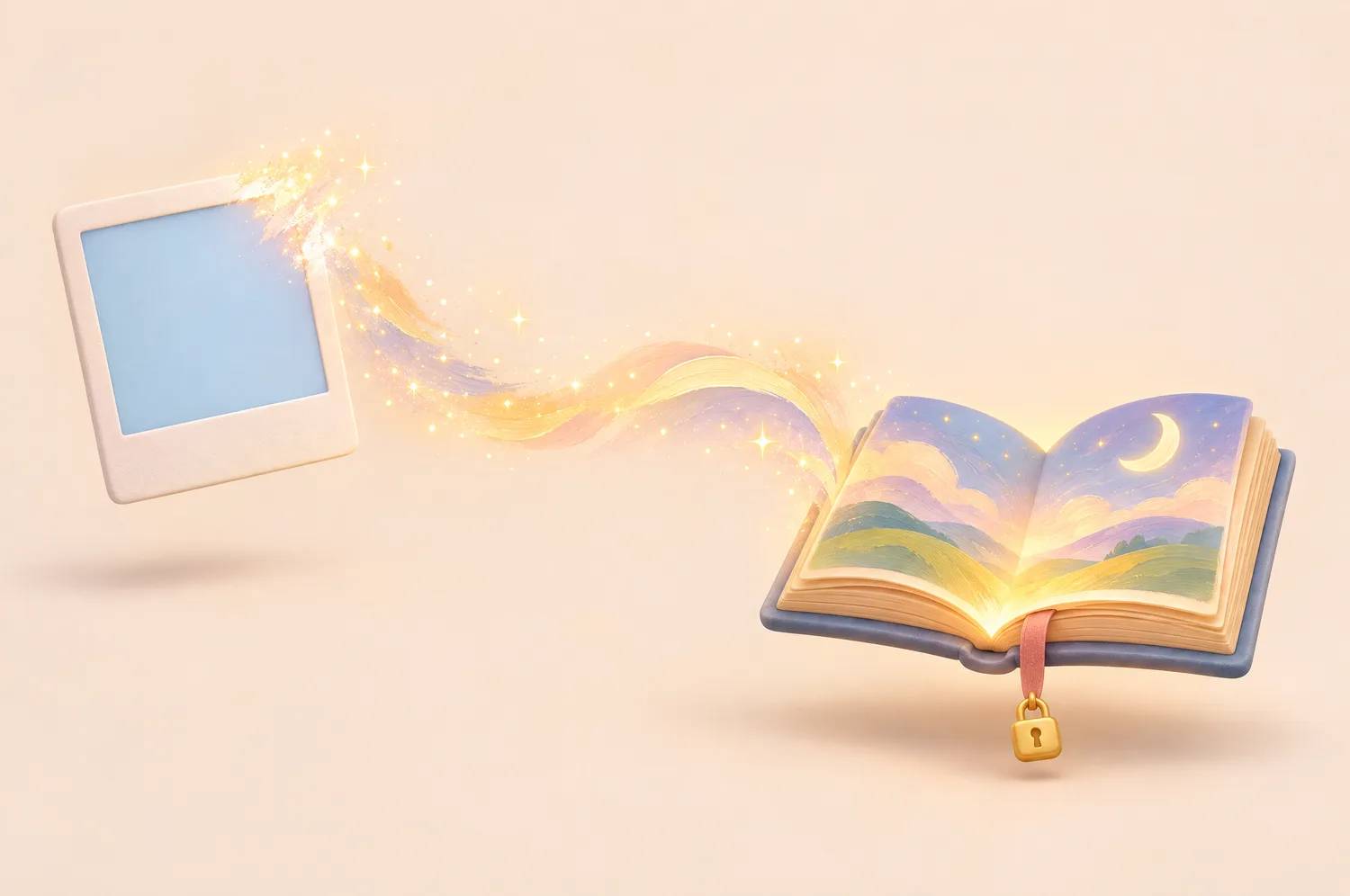
Straight from our privacy policy and the code that runs the product:
- Used to draw, then not kept. We use your photo to draw your child's character, and we don't save the original.
- We keep the drawing, so you can personalize your stories and we can make your book.
- Never used for training. We do not use customer data, including uploaded photos and the characters made from them, to train AI models.
- Delete anytime. Email support@magicstory.com and we'll delete your child's character and data.
Ask before you upload: a parent's checklist
Before you upload your child's photo to any AI or kids' app, ours included, ask:
- Do you keep the original photo? For how long, and where does your privacy policy say so?
- Do you train AI on my child's photo, or on the images you make from it?
- Do you create a face scan or faceprint? If so, where's the consent, and when is it destroyed?
- Who else gets the photo, and why?
- How do I delete everything?
- Is the result photoreal? If it leaked, could it pass for a real photo of my child?
- Who can see what you make? Is anything public by default?
- Must the uploader be the parent or guardian, or have their permission?
Red flags: vague answers, "we may use your content to improve our services" with no promise about AI training, no clear way to delete, and public galleries by default. Our answers are on this page and in our privacy policy. Hold us to them.
2. Kids connect with pictures, and with themselves in them
Watch a preschooler at story time. They aren't reading the words; they're reading the pictures. In an eye-tracking study, Evans and Saint-Aubin (2005) found preschoolers "spent very little time examining the print" while an adult read aloud.
Put the child in the story and the response changes. Researcher Natalia Kucirkova and colleagues found preschoolers learned new words better from a book's personalized sections than from its ordinary ones (Kucirkova, Messer and Sheehy, 2014; 18 children, average age just under 4). In an earlier home study, toddlers smiled, laughed and vocalized more with personalized books (Kucirkova, Messer and Whitelock, 2013; 7 families). Both samples are small: promising, not proven.
And realism isn't what preschoolers reach for. When 92 children aged 3 to 5 chose which characters they'd rather learn from, they picked animated characters over live-action ones and "showed little sign of prioritizing realism" (Snyder and Mares, 2021).
To be fair to the research: for babies and young toddlers learning what a real cup or a real dog looks like, realistic pictures help (Ganea, Pickard and DeLoache, 2008). A Magic Story book has a different job. It's made for ages 2 to 10, it isn't a flashcard, and it puts your child inside a story where they get to be brave, kind and a little bit legendary.
3. The sweet spot: unmistakably your kid, unmistakably a storybook
Unmistakably your kid
Your phone photo in, a storybook hero out.

Example photo. The character on the right was made by the same Magic Story pipeline every order uses.
Likeness is where we go furthest. Some personalized books build the hero from a menu, which gives you a stand-in who resembles a category of child. We draw the actual kid in your photo. Our character pipeline is built to capture what makes your child them:
- their distinctive face shape and age, not a generic doll face
- their natural complexion
- their haircut, hairline, parting, curl size and braid or twist pattern, with beads and hair ornaments kept in place
- glasses, jewelry and their favorite shirt
- tooth gaps and braces, moles, birthmarks and freckles
In books with detailed eyes, you also pick their eye color so the drawing gets it right. If it's visible in the photo, the drawing is designed to keep it.
Unmistakably a storybook
So why not go all the way to photoreal? Because almost-real faces can feel wrong. In 1970 the roboticist Masahiro Mori proposed the "uncanny valley": the more humanlike something looks, the more we warm to it, until it gets close but not quite right and warmth turns to unease.
The evidence since is mixed. A 2015 review called it "inconsistent" overall, with the best support for one trigger: mismatched cues, such as a realistic face with artificial-looking eyes (Kätsyri and colleagues). And children grow into the feeling: in a study of 240 kids aged 3 to 18, those older than 9 found a very humanlike robot creepier than a machine-like one, while younger children didn't (Brink, Gray and Wellman, 2019).
Our view: a near-photo of your child with a slightly wrong hand or an odd glint in the eye is unsettling in a way a painted storybook face isn't. Illustration is honest about what it is. And it can go anywhere: dragons, deep space, the North Pole.
The idea we built on
In 1960 the plastic surgeon Maxwell Maltz published Psycho-Cybernetics, arguing that the way we picture ourselves shapes what we attempt. We built Magic Story around a simple idea in that spirit: a child who sees themselves as the hero, again and again, gets to try that picture on.
Albert Bandura's research on self-efficacy found that watching someone succeed raises our belief that we can do it too, and that the effect is strongest when the person we watch is like us. In video self-modeling, children watch edited footage of themselves succeeding at something, and it's recognized as an evidence-based practice for autistic children (National Clearinghouse on Autism Evidence and Practice, 2020). A storybook isn't therapy, and we don't claim it is. But the principle is the one we built on: seeing yourself succeed is powerful.
We can't promise any particular outcome, and we won't. We can promise the hero looks like your kid.
Made like a keepsake
Every personalized book is printed to order for one child, as a hardcover as standard, with their name throughout: a one-of-one keepsake. Families made 200,000 Magic Story books in a single year, we now make more than 1,000 a day, and more than 200 new books are on the way. In the US most books are $44.99 on their own, or $24.99 with a Magic Story+ membership. Some books and sets are priced differently; shipping and tax are added at checkout.
Start with one photo and a free preview. See your child drawn as the hero before you spend a cent, and if it's not quite them, tap Try again.
Questions parents ask
Does Magic Story keep my child's photo?
No. Your photo goes to the image model that draws your child, and we don't save the original. We save the illustrated character so you can personalize your books and we can print your order.
Does Magic Story use my child's photo to train AI?
No. We do not use customer data, including uploaded photos and the characters made from them, to train AI models.
Why doesn't Magic Story make realistic AI photos of children?
A photoreal image of a real child could pass for a real photo, and the FBI warns that true-to-life fakes can be extremely difficult to remove once they circulate. An illustration is obviously a drawing, and it can take your child anywhere.
Will the illustrated character really look like my child?
That's the point. Our pipeline is built to keep face shape, complexion, hairstyle, glasses, freckles, birthmarks and tooth gaps. You see the character in a free preview before you buy, and you can tap Try again for another version.
How do I delete my child's character and data?
Email support@magicstory.com and we'll delete it.
What should I ask before uploading my child's photo to any app?
Ask whether they keep the photo, train AI on it or create face scans, who else receives it, how to delete everything, and whether the results could pass for a real photo of your child.


