How Being the Hero Shapes Kids’ Confidence
Boost your child’s confidence with the power of storytelling! Discover how personalized books help build self-belief, resilience, and a positive self-image.

4 min read | February 4, 2025 · Updated July 19, 2026
Kai is five, and for most of a school year she wouldn't raise her hand in class, even when she knew the answer. Her parents tried the usual encouragement — "you're so smart," "just try it" — and none of it moved her.
What did move her, eventually, was a story where a character who looked like her raised her hand, got the answer half wrong, and kept going anyway. Kai asked to hear that page again the next four nights in a row. By spring, she was raising her hand — not every time, and not without a flicker of nerves, but she was doing it.
Can Confidence Really Be Taught?
Not directly — you can't hand a child confidence the way you'd hand them a fact to memorize, but you can build the experiences that let it form. Every parent wants to raise a child who believes in themselves, takes on challenges, and grows from setbacks, and the research on this points less toward what parents say and more toward what children get to practice. Storytelling, especially when children see themselves face and overcome a challenge, appears to be one of those practice grounds.
What Is the "Mirror Effect," and Does It Actually Build Confidence?
The mirror effect describes what happens when a child sees a positively represented version of themselves succeed in a story: they get a chance to internalize that outcome, mentally rehearse it, and carry a trace of that self-belief past the end of the book. One Psychology Today piece, drawing on a systematic review of studies published between 2012 and 2022, describes storytelling as supportive of resilience, imagination, and perspective-taking in children — while its author is careful to add that storytelling "is no panacea," and that factors like genetics, environment, and family dynamics all play a role too. That caveat is worth keeping in view: stories are one input among several, not a substitute for the rest of a child's environment.
Within that more modest frame, the mirror effect still does real work, and it's the same dynamic explored in our piece on how personalized books support kids' confidence and curiosity. A personalized story, where a child sees themselves specifically as the main character rather than a generic stand-in, gives the mirror effect a sharper reflection to work with.
How Do Personalized Stories Build Confidence, Specifically?
Books offer more than motivational phrases — they offer something closer to an experience a child can walk through and revisit. Four mechanisms tend to show up in the research and in practice:
| Mechanism | What it does |
|---|---|
| Personal connection | A National Literacy Trust literature review of personalized-book research examines confidence, motivation, and aspiration as part of what personalization may influence in shared reading. |
| Emotional rehearsal | Stories provide a low-stakes space to practice handling a difficult situation before facing a real version of it. |
| Identity building | Regular exposure to positive self-representation is associated with stronger self-confidence, according to The Linking Network, which studies representation in children's literature. |
| Memory making | A physical book a child returns to becomes a repeatable reminder of a moment they got through, reinforced each time they revisit it. |
What Does This Look Like in an Actual Story?
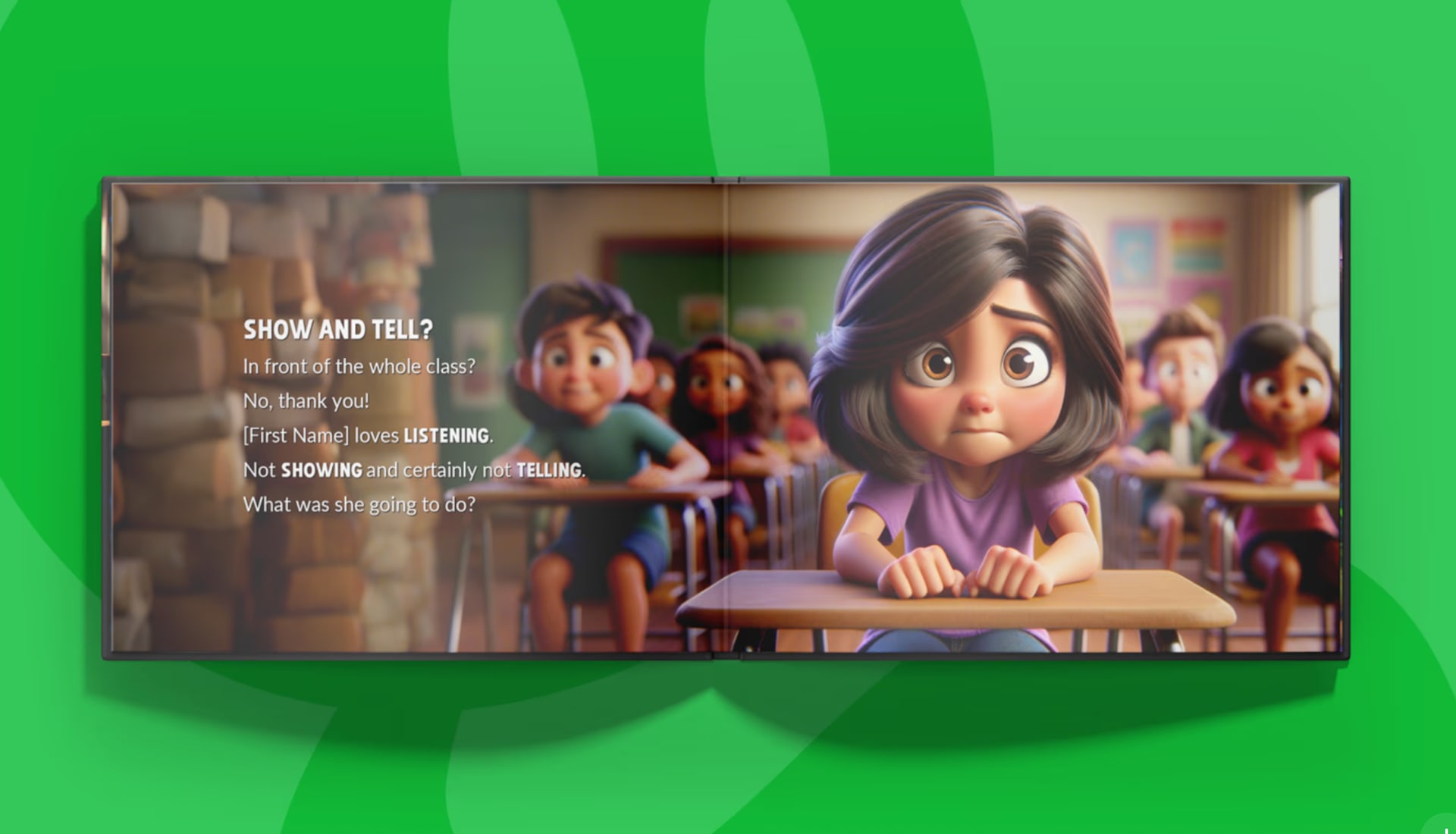
One clear example is Marco and the Very Scary Show and Tell, a personalized story built around a child overcoming the fear of speaking in front of a crowd. In it, a child teams up with Marco, a chatty parrot, to work through Show & Tell anxiety at school. Through a series of small, quirky exercises, the character discovers that it isn't about sounding perfect — mistakes matter less than trying, and self-expression matters more than fear.
By the end of the book, the takeaway isn't that fear disappears. It's that confidence isn't the absence of fear; it's trying despite it — which is the same idea explored further in our guide on a child scared of Show & Tell building speaking confidence, and it echoes the broader mechanism behind why visualization matters for a child's success: rehearsing the hard moment, in story form, before having to live it.
Kai's parents didn't read her a lecture about bravery. They read her a story where someone who looked like her got it half wrong and raised her hand anyway — and then let her ask for that same page, again and again, until it stopped feeling like someone else's story and started feeling like a rehearsal for her own.
Frequently Asked Questions
Can confidence really be taught, or are some kids just born with it?
Confidence isn't something you can simply tell a child to have — it's nurtured through experiences that reinforce self-belief. Storytelling, especially when children see themselves face and overcome challenges, appears to support building lasting confidence and a positive self-image, though it works alongside other factors like temperament and family relationships, not in place of them.
How do personalized stories build a child's confidence?
When children see themselves as the hero of a story, they internalize positive messages, mentally rehearse overcoming challenges, and develop self-belief that extends beyond storytime. This mirror effect lets children see versions of themselves succeeding, reinforcing self-worth. A personalized book strengthens the effect by making your child the main character, turning every adventure into an affirmation of their courage and abilities.
How is a personalized book different from just telling my child 'you can do it'?
Books offer more than motivational phrases — they provide experiences. Through personal connection, emotional rehearsal, identity building, and memory making, a personalized story lets a child practice handling difficult situations in a safe space and relive their victories each time they re-read it, which does more for self-belief than encouragement alone.
Which Magic Story book helps with confidence and public speaking?
Marco and the Very Scary Show and Tell. Your child teams up with Marco, a chatty parrot, to overcome the fear of speaking in front of a crowd at school Show & Tell. Through confidence-building exercises they discover it's not about sounding perfect but about sharing their voice — learning that confidence isn't being fearless, it's trying despite the fear.