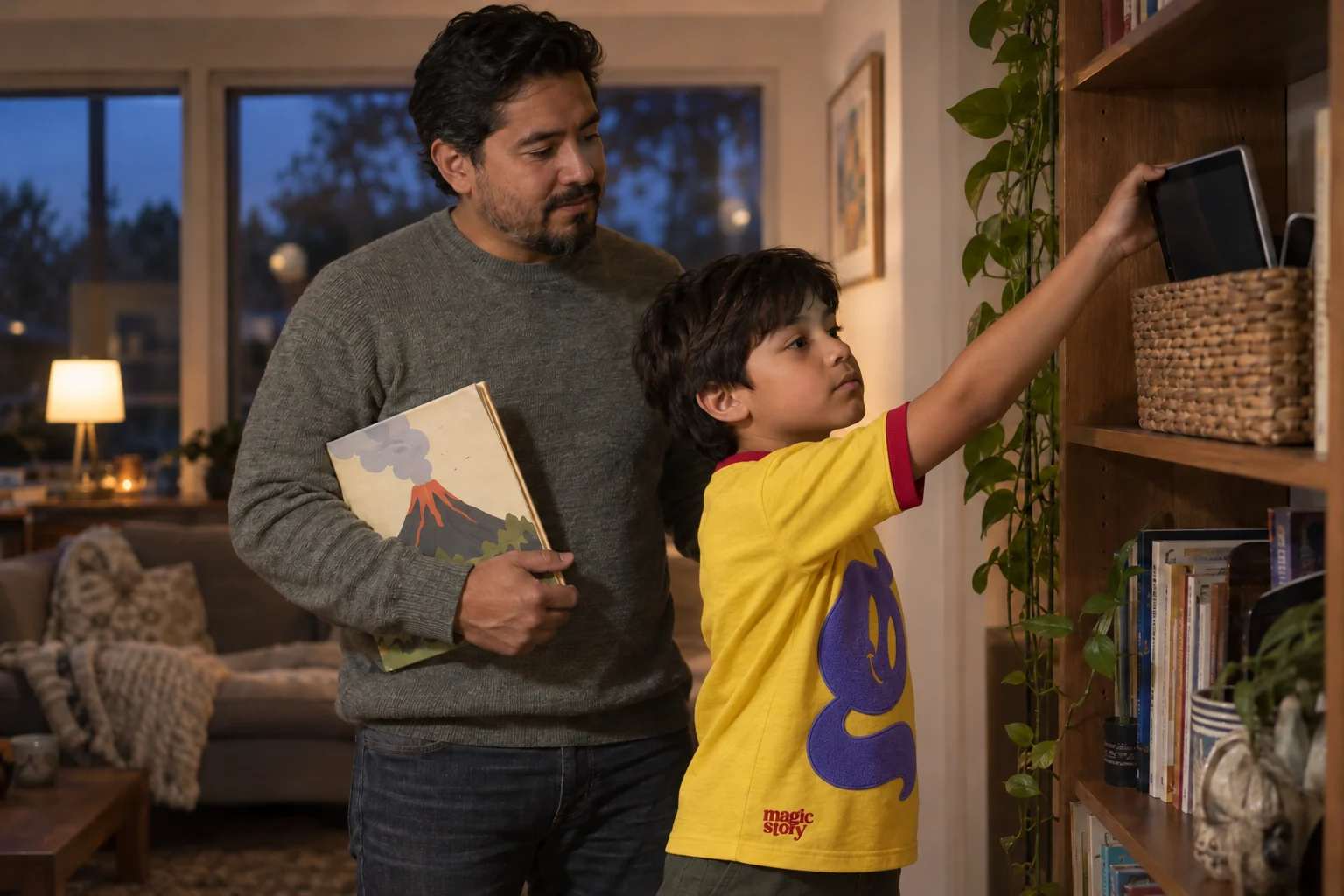
Print Books and E-books: Choosing What Works for Your Child
A balanced look at print books and e-books, with research on shared reading and practical questions about attention, access, and bedtime.


In this article
A printed picture book is easy to put between two people. You can hold a page open, point at a detail, and turn back without opening a menu. It does not need charging, and the story ends when you close the cover.
Those are useful reasons to keep print books within reach. They do not make every e-book a poor choice. Digital books can offer larger text, narration, or access to a title your family could not otherwise borrow. Look at the particular book and the way your child uses it.
What the comparison studies actually found
In a 2019 study of 37 parent-toddler pairs, families talked more about the story and collaborated more with print books than with the electronic versions tested. Tablet-related exchanges took more space in the digital sessions. This was a short laboratory study of particular books, not a finding about every device or every child’s long-term literacy.
A 2017 study using different books with younger toddlers found advantages for the electronic versions in attention and a specific word-learning task. Taken together, the studies caution against a simple claim that one format always wins. Book design, the child’s age, and what researchers measure matter.
For family use, a useful question is: Does this book leave us room to read and respond to each other?
Choose around the experience you want
| If you need | A print option | A digital option to consider |
|---|---|---|
| A simple story before bed | A familiar book with an ending you can reach comfortably | Choose a different time for an on-screen story if you are protecting the pre-bed screen break. |
| Easier access to the text | Large-print editions or a book stand | Adjustable type, contrast, or other accessibility settings, where available |
| Stories during travel | One or two light favorites | Borrowed e-books downloaded in advance, if the app allows it |
| A book in a family language | Bilingual books or editions from a library | A digital edition in the language you want to share |
| A story with a distant relative | A copy of the same book in each home | A planned video reading session or a shared digital edition |
Availability varies by library, publisher, device, and app. Check a feature before relying on it for a trip or buying a book because you expect it to be included.
Make a digital story easier to share
Open the book before inviting your child to read. Deal with logins, downloads, and volume settings first. Where possible, silence unrelated notifications and turn off automatic transitions that rush the page.
Position the screen so you can both see it. Pause narration if someone wants to talk. If most of the session becomes a discussion of buttons or taps, try a simpler edition or a print copy and see whether it is more comfortable.
An audiobook is another option for enjoying a story, including when a child wants to draw or rest their eyes. Listening to narration and independently decoding printed words are different activities; both can have a place in a child’s day.
Give bedtime its own plan
The AAP’s sleep guidance recommends turning screens off at least an hour before bedtime. A printed book is a straightforward way to offer a story during that time.
Keep enough light to see comfortably. Choose a length that fits, and avoid stretching bedtime just to finish the last pages. A familiar story can work well in a short bedtime routine.
If your child uses a device for communication or another essential access need, discuss sleep routines with the professionals who know them. General screen advice should not be used to remove a child’s way of communicating.
Choose a gift for the child who will use it
For grandparents or other gift-givers, ask what the child enjoys and how the family shares books. A printed favorite can travel between homes and hold a handwritten dedication. An accessible digital edition may be more usable for a particular reader.
With a personalized book, look at the story and preview as carefully as you would with any other purchase. A child’s name on the cover does not establish a reading or sleep benefit. Avoid assuming that buying a print book includes every digital feature you have seen advertised elsewhere; check the current product information.
Watch the reading, not just the format
Notice what you and your child actually do. Can they see the page? Can you pause? Is there room for a question? Do they want to return to the book?
If one format is awkward, try another. You can keep printed books as a regular part of family life while using digital tools where they make a story easier to reach. For the wider routine, see making room for reading in a home with screens.
Sources
Questions parents ask
Are printed books always better than e-books for children?
No. Studies of particular books and age groups have produced different results. Print can make shared reading simple; digital books may offer useful access features. Look at whether the format helps your child follow and share the story.
Why choose a printed book before bed?
The AAP recommends avoiding screens during the hour before bedtime. A printed book offers a story during that break without needing a device. Reading still does not guarantee easy sleep.
What should I check before using an e-book with my child?
Check that you can both see the page, pause when needed, and control unrelated notifications or automatic transitions. Confirm downloads and accessibility features before relying on them.