The Science of Reading Together: Why Bedtime Stories Build Core Memories That Last a Lifetime
Discover the neuroscience of reading with your child - how shared stories activate mirror neurons, form core memories, and shape brain development ages 2-7.

16 min read | February 20, 2026 · Updated August 16, 2026

Discover how shared reading literally rewires your child's brain - and creates the kind of memories they'll carry into adulthood.
The Moment That Changes Everything
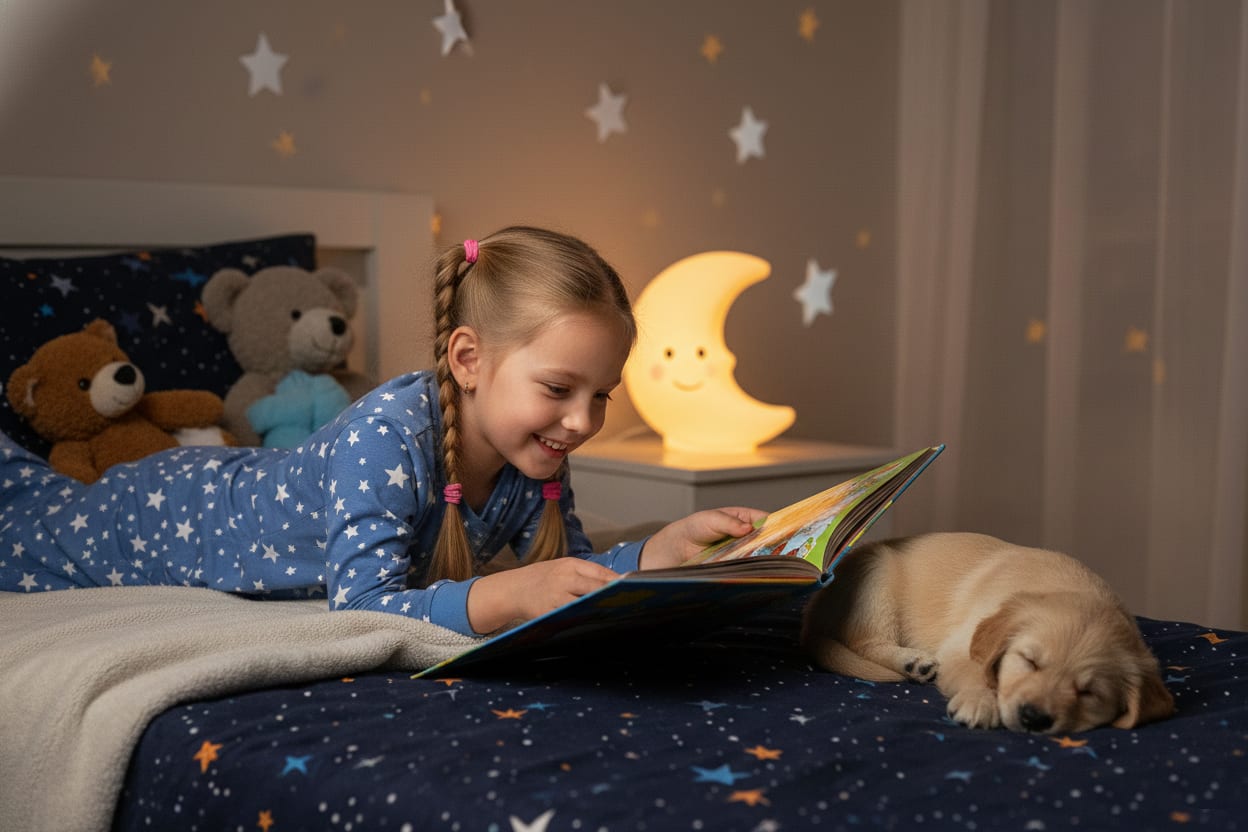
Picture this: It's 7 p.m. on a Tuesday. You're sitting in the worn leather armchair by your child's bed, their small body nestled against your chest. You open a book - maybe it's one you've read a hundred times before - and begin. Your child's eyes widen. Their breathing slows. Their tiny hand finds yours.
That moment feels magical. Warm. Simple. But here's what you might not realize: that moment is literally rewiring your child's brain. Thousands of neural connections are forming. Hormones are being released. A memory is crystallizing - one that might shape their emotional development, their academic success, even their capacity for empathy throughout their entire life.
It sounds like we're overselling it. We're not. The science behind reading together is actually this powerful, and it's part of why bedtime stories matter more than you might think.
For decades, researchers have studied what happens when a parent and child share a book. And the findings are consistently remarkable. Reading together isn't just a nice thing to do before bed. It's a fundamental developmental experience - one that activates multiple systems in the brain simultaneously and creates the exact conditions needed for forming the kinds of memories that last.
Let's talk about what's actually happening in those quiet moments with a book.
What Actually Happens in the Brain When You Read Together?
Shared reading activates a sophisticated neural exchange between two brains at once: mirrored neural firing, synchronized brain activity, an oxytocin release triggered by physical closeness, and active cognitive engagement through conversation. None of this requires effort on your part beyond showing up and reading. Here's what's happening in each layer.
Mirror Neurons Fire in Both of You
Mirror neurons fire both when we perform an action and when we observe someone else performing it. Related research on story listening finds that hearing a narrative activates sensory and motor brain regions in ways that resemble actually experiencing the events described — evidence of mirror-neuron-like simulation during storytelling (Speer et al., 2009). Your child sees you holding the book and hears the wonder in your voice as you describe a character's adventure, and their brain mirrors that. This is why a story told with genuine warmth lands differently than the same story read in a flat, distracted voice.
Parent and Child Brains Synchronize
Brain-imaging research on parent-child shared reading has found that parent and child neural activity becomes more synchronized during the activity, and that greater synchrony is associated with stronger language outcomes for the child (neural synchrony and shared reading, Cerebral Cortex). You're moving through the story at the same pace, hearing the same words, and creating shared meaning together.
Physical Closeness Triggers Oxytocin
Sitting close together, often with your child leaning against you or in your lap, is the kind of physical contact that research links to oxytocin release, sometimes called the "bonding hormone" (oxytocin and parent-child interaction: a systematic review). Oxytocin doesn't just feel good — it's associated with memory formation, social attunement, and secure attachment. The lap, the warmth, and the voice aren't peripheral details. They appear to be core to the effect.
Conversation Activates Multiple Brain Systems
When you pause to ask "What do you think happens next?" or your child points to a picture and asks "Why is he sad?", that back-and-forth, known as dialogic reading, activates language processing, theory of mind, executive function, and memory encoding all at once. A parent and child talking about a story together is a sophisticated cognitive experience, not just a cute moment.
All of this combines to create a state of deep engagement and safety. Your child's amygdala, the brain's threat-detection center, quiets down. Their prefrontal cortex, the region responsible for learning and memory consolidation, lights up. They're in what neuroscientists call an optimal learning state: calm enough to process information, engaged enough to pay attention, safe enough to take cognitive risks. This is the neurological foundation for memory formation.
How Do Core Memories Actually Form?
Core memories form when an experience combines multi-sensory input, emotional charge, and social connection — and research suggests shared reading naturally provides all three. Neuroscientists call these lasting, personality-shaping memories "episodic memories," and the brain builds and stores them differently than it stores plain facts.
The memories most likely to carry into adulthood aren't individual facts or lessons. They're episodes: specific moments with rich sensory detail, emotional significance, and social context. It's the difference between knowing that Paris is the capital of France versus remembering the afternoon your parent took you to a bookstore, the smell of old paper, their laugh when you knocked over a display, sitting together afterward with hot chocolate.
1. Multi-Sensory Engagement
The brain encodes memories more strongly when multiple sensory modalities are involved. Reading together provides this naturally: visual (the pictures), auditory (your voice), tactile (the feel of the book, the warmth of being held), even olfactory (many people remember the smell of a beloved childhood book). The more sensory channels engaged, the stronger the memory encoding.
2. Emotional Charge
The amygdala, which processes emotions, also modulates memory formation. Emotionally significant experiences are consolidated more strongly into long-term memory. When a story makes your child laugh, gives them a little thrill of fear (safely contained), or moves them to tears, you're activating this emotion-memory connection. The feelings matter because they cement the memory.
3. Social and Relational Context
We remember moments that feel important socially. The presence of an attachment figure during a meaningful experience increases memory consolidation, and talking about an experience together afterward — sometimes called social contagion of memory — encodes it even more deeply as a shared memory. Your child remembers not just the story, but that they experienced it with you.
Reading together hits all three conditions at once. That's why a childhood of shared reading creates episodic memories that last — memories that actively shape how a person sees themselves, understands others, and approaches the world.

Why Do Ages 2-7 Matter Most for Reading Together?
Ages two through seven are a period of extraordinary neural development, when the brain undergoes rapid synaptogenesis, the formation of new connections, in regions tied to language, executive function, and social-emotional understanding. This window of maximum neural plasticity is when reading experiences are most likely to shape lasting brain architecture, not just build memories.
Not all periods of childhood carry equal weight for reading's impact, and this window is where the science points to the biggest returns.
During this window, children are experiencing a vocabulary explosion. Research on early language development consistently shows a rapid acceleration in word learning between ages two and three, with children's active vocabularies expanding by the hundreds within about a year — and that growth accelerates further between three and five. Reading together is one of the most powerful predictors of vocabulary growth, not because you're drilling words, but because stories provide words in meaningful, emotionally engaging contexts. Your child hears a new word embedded in a narrative, sees it connected to a picture, and hears you use it naturally, all of which creates robust, flexible word knowledge.
This is also the period when theory of mind develops: the cognitive ability to understand that other people have thoughts, beliefs, and desires separate from your own. Stories are the tool for developing theory of mind. When a character wants something different from what your child wants, or is surprised, afraid, or hopeful, your child is exercising the neural circuits needed to understand other minds.
Ages 2-7 vs. Later Childhood
| Ages 2-7 | After Age 7 | |
|---|---|---|
| Neural plasticity | Maximum — rapid synaptogenesis | Still plastic, but slower |
| Vocabulary growth | Explosive — rapid word-learning acceleration | Steadier, incremental |
| Theory of mind | Actively developing | Largely established |
| Impact of reading | Shapes foundational brain architecture | Builds on existing architecture |
That's not to say reading matters less after age seven. It doesn't. But the kind of foundational, brain-shaping impact is greatest during this window, when hundreds of hours of warm, engaged reading build different neural pathways than a childhood without it.
Why Does the Brain Process Stories Differently Than Facts?
When your child hears a fact, their brain decodes and files it away using language-processing regions alone. When they hear a story, their brain simulates the experience: motor and sensory regions activate alongside language centers, so they don't just learn the information, they feel it. This is why a child might forget a fact heard once but remember a story heard a hundred times.
Facts Are Decoded. Stories Are Simulated.
When you hear a fact — "flamingos are pink because of a pigment in their food" — you decode the information and might store it, but that's mostly where it stops. When you hear a story about a flamingo who felt lonely until she found a flock that made her feel at home, something different happens. The language-processing regions activate, but so do the regions associated with sensory experience: if the story mentions wading through water, the motor cortex lights up; if it describes the sun's warmth, the sensory cortex activates. The brain is simulating the experience, not just decoding information.
Narrative Transportation and Embodied Cognition
Neuroscientists call this "narrative transportation": when your child is absorbed in a story, their brain is transported into it, rather than analyzing it from a distance. This experiential learning creates different memory traces and different neural changes than passive information delivery.
Stories also engage "embodied cognition," the idea that understanding is grounded in physical and sensory experience. Your child doesn't just learn that a character was scared; they experience something close to fear. They don't just learn that friendship matters; they feel the relief and joy when characters reunite. This felt understanding is stickier and more likely to influence behavior and belief.
Predictive Processing Keeps the Brain Active
There's also "predictive processing" at work: your child's brain is constantly trying to predict what happens next, actively constructing meaning and revising predictions rather than passively receiving information. That's cognitively demanding and neurologically powerful, and it's part of why narrative is how humans have always learned, not through instruction manuals, but through stories.
And when that story is read aloud, by someone your child loves, in a voice carrying emotion and intention, the effect is magnified.
Does the Parent's Presence Matter as Much as the Book Itself?
Yes. Research on shared reading consistently finds that the relational context matters as much as the content: children who are read to regularly by an engaged adult tend to show stronger development not just in language areas, but also in regions associated with social-emotional processing. The effect isn't only about exposure to words and stories — it's about a trusted adult engaging with them, responding to them, and creating a safe space for their attention and curiosity.
Think about what happens during a shared reading experience. Your child might ask a question, sometimes about the story, sometimes a complete tangent. You pause, you respond, you take their question seriously. Your child experiences themselves as someone whose thoughts matter, whose questions are worth your time and attention.
Or maybe your child gets scared at a particularly intense part of the story. You notice, you slow down, and you reassure them: "This is a scary part, but the character is going to be okay." Your calm voice, your continued presence, and your acknowledgment of their feeling while modeling safety is co-regulation in action — your nervous system is literally helping to regulate theirs.
This is why audiobooks and screen-based stories, while not without value, aren't quite the same — see why kids need physical books, not screens for more on this. The two-way interaction, the responsiveness, and the physical presence create a qualitatively different experience. Reading together is a relational ritual, not just a content delivery system.
It's also why the quality of attention matters. A parent reading while scrolling on their phone, or reading in a tense, distracted voice, creates a different experience than a parent who is fully present. Your child can sense your attention or the lack of it — they're reading your face, your tone, your body language. When you're truly present, they feel held.
What Does Long-Term Research Show About Reading Together?
Children who are read to regularly show better academic outcomes across the board: stronger language skills, better reading comprehension, and higher vocabulary. Research also points to benefits beyond academics, including gains in emotional regulation and social skills, though the size of these non-academic effects varies by study.
Reach Out and Read, a pediatric-based program built on decades of research into parents reading aloud to young children, points to measurable gains in language development and school readiness, alongside a growing body of evidence for social-emotional benefits. Other research has found associations between early shared reading and executive function (the ability to plan, organize, and complete tasks), emotional intelligence, and reduced likelihood of behavioral difficulties. None of these outcomes are guaranteed by reading a few books, but the evidence consistently points toward a developmental advantage for children who grow up with shared reading.
Perhaps most importantly, these benefits aren't just about skill development. They seem to shape something deeper: how children see themselves, how they relate to others, how they approach learning and challenge. A child who has spent years experiencing themselves as worthy of their parent's time and attention is fundamentally different from one without those experiences.
The memories formed during shared reading aren't incidental. They're building blocks of identity and emotional security.

How Can You Make the Most of Reading Time?
Understanding the science is great, but a few concrete habits are what actually create the conditions for reading to have this kind of impact: consistency, conversation, presence, and letting your child lead.
- Prioritize consistency over volume. One shared reading session a day, consistently, is more powerful than occasional extended reading marathons. Daily reading lets your child's brain consolidate memories and build the ritual into a core part of their day.
- Practice dialogic reading. Don't just read the words — pause to ask questions like "What do you think will happen?" or "How is the character feeling?" Let your child ask questions too, even if they interrupt the story.
- Let your child lead sometimes. It's good to have a plan, but it's also good to reread favorites obsessively, flip back to specific pages, and follow your child's interests rather than your own reading agenda.
- Read with genuine presence. Put the phone away, make eye contact, and let your voice carry feeling. Your presence is the context for everything else.
- Choose books thoughtfully, but don't obsess. What matters most is the act of reading together, not the particular books, though books with diverse characters and opportunities for conversation do seem to add a bit more.
- Remember that re-reading is powerful, not boring. If your child wants to hear the same book a hundred times, that repetition is serving their brain — consolidating language, building new connections, and reinforcing the safety of the familiar.
Beyond these practices, the most important thing is simply to start, or to continue if you're already reading together — the goal our guide to raising a book-loving kid in the age of screens digs into further. You're not just filling time before bed. You're shaping your child's brain, encoding memories, and building their capacity for language, empathy, and imagination.
Why Does It Matter When a Child Sees Themselves in the Story?
Research on representation in literature suggests that children engage more deeply with stories when they see characters who reflect their own identity — their appearance, their family structure, their interests. The character becomes a mirror rather than just an imagined figure, and the child's investment in the narrative deepens.
Some approaches in children's publishing, like personalized books where a child's own face appears throughout the story, extend this further: when a child sees themselves as the hero rather than just a relatable character, the story can feel more personally relevant and memorable.
It's an interesting application of the neuroscience already at work in shared reading — taking the same principles of engagement, emotional investment, and memory formation, and maximizing them by making the story personal to the child experiencing it.
The Lasting Gift
Here's what the science really comes down to: reading together with your child isn't a nice-to-have activity you fit in when you have the time and energy. It's a fundamental developmental experience — one that activates multiple systems in the brain simultaneously, creates the exact conditions for forming lasting memories, and shapes how your child develops emotionally, linguistically, and socially.
The memories formed during those quiet moments with a book — the specific warmth of a particular afternoon, the sound of your voice, the feeling of safety and attention — aren't nostalgic flourishes. They're building blocks of your child's developing brain, wiring how they'll relate to stories, to learning, to themselves, and to others for the rest of their life.
You don't need perfect books, or to read the "right" amount, or to optimize the experience. You just need to show up, be present, and let your child feel that they matter enough to deserve your attention. That's the core of it.
Go back to that Tuesday evening: the worn armchair, the book you've read a hundred times, the small hand finding yours. That moment was never just about getting through one more story before lights-out. It was your child's brain, wiring itself around your voice, your warmth, your presence - one ordinary evening at a time.
That's not indulgence. That's neuroscience in action.
Frequently Asked Questions
At what age should I start reading to my child?
It's never too early. Newborns benefit from hearing your voice, feeling your presence, and experiencing the rhythm of language; infants and toddlers begin to engage with images and narrative. The exact comprehension isn't the point — the relational experience is. Start whenever feels natural, knowing that even reading to a newborn is building neural pathways and strengthening your bond.
What if my child won't sit still for a full book?
That's completely normal, especially for younger toddlers. Read short books, or just read for as long as your child is engaged — a five-minute shared reading experience is still a powerful neurological event. As your child's attention span develops naturally during the 2-7 window, so will their capacity to sit with longer books. There's no prize for finishing a book.
Do I need to choose 'educational' books specifically?
Not at all. The research doesn't distinguish between 'educational' and other books — any book that engages your child and creates a space for connection is doing the work. Books with repetitive language, diverse characters, and opportunities for conversation do seem to add benefits, but a silly picture book your child loves is just as valuable as a 'learning book.'
Does reading aloud matter more than reading independently?
Reading aloud has distinct neurological benefits — the relational component, the tone and emotion in your voice, and the opportunity for interaction. As children grow and learn to read independently, that builds different skills and its own engagement. Ideally both happen, but if you're deciding where to focus energy with a young child, shared reading aloud is uniquely powerful.
Can screens provide the same benefit as reading books?
Screens can deliver stories, and there's value in that, but they miss key ingredients: the two-way interaction is limited, the physical closeness is reduced, and the parent's ability to respond to the child's individual experience is constrained. For maximum benefit, physical books with a present, engaged parent are hard to beat — screen time is simply a different, less neurologically rich experience than shared reading.