Are Magic Story Books Made for Kids With ADHD? An Honest Answer
Magic Story books weren't made for ADHD and don't treat it. Here's the honest case for why a story starring your child can be easier to stay with.

In this article
- The short version
- Attention goes where interest goes
- Five things in the book that work in your child's favor
- Picture it: one book, two pages
- How to read it with a child who can't sit still
- If your child is autistic, has ADHD, or both
- What a book can't do
- See your child as the hero before you spend anything
- Sources
No. Magic Story books weren't made for ADHD, and they don't treat, manage or improve ADHD, autism or anything else. They're picture books where your child is the hero, drawn from their photo and called by name.
Parents ask us anyway, some because their child has ADHD, is autistic, or both. The question underneath is a better one: my child has a hard time staying with a book, so why would this one be any different? That question has a real answer. A story that stars your child has several things going for it when focus is hard, and research on young children offers some clues about why. Here's the case, where the evidence stops, and how to check for free whether it fits your child.
The short version
| What we can say | What we can't |
|---|---|
| Your child is the hero: drawn from their photo and named in the story. | That a book treats, manages or improves ADHD or autism. |
| Every story page is a full-color illustration, and the book is read aloud with a grown-up. | That it will make any child pay attention. |
| Small studies of young children link a child's own face, and personalized books, to better memory for what they saw, more smiles and laughter, and better learning of new words. | That anyone has tested Magic Story books with children who have ADHD or are autistic. Nobody has. |
| You can see your child as the hero, free, before you buy. | That every child likes seeing themselves in a book. Some don't. |
Attention goes where interest goes
Does your child drift off halfway down a page, but stay locked on sharks, trains or a favorite video game for an hour? Then you already know the most useful thing about their attention: it follows what they care about.
So the first question to ask about any book isn't whether it was made for ADHD. It's whether it's about something your child can't resist. A personalized book starts with an advantage there, because the subject is them.
There's research behind that hunch. In a 2020 study, 138 children aged four to six were shown drawings of objects next to a photo of either their own face or another child's. They were better at remembering the objects, and which face each one went with, when the face was their own. The researchers' reading is that a child's own face grabs their attention (Andrews, Murphy and Dunbar). That was a memory game, not a storybook, and it wasn't a study of ADHD. But it describes the moment a personalized book is built around: a child spots themselves and looks closer.
Small studies of personalized books point the same way. When researchers watched seven families read with toddlers, they compared a personalized book, a comparable book that wasn't personalized, and a favorite book. Some behaviors, including smiles and laughter, were more frequent with the personalized one. In another study, 18 preschoolers knew the new words from the personalized parts of a book better than the words from the rest, at two of three test points. We walk through both, and their limits, in personalized books and learning.
Five things in the book that work in your child's favor
None of these is a treatment. Each one takes away a reason a child might give up on a story.
- The hero is them. Their character is drawn from their photo, and the story calls them by name. A child who drifts from a story about somebody else has a reason to check what "they" are doing on the next page. Our guide to how a Magic Story book is made shows the whole process.
- The pictures tell the story. Every story page is a full-color illustration, and most books have 21 to 28 of them. A child who misses half the words can still follow what happened by looking, and can rejoin the story on any page.
- It comes in small pieces. A picture book is already cut into short scenes: one page, one picture, a few lines. You can stop after any of them and still have read something whole.
- A grown-up reads it with them, and how you read matters. These are read-aloud books, so your voice, your pace and your attention do much of the work. The American Academy of Pediatrics recommends that pediatricians encourage families to read together, starting in infancy. In a randomized trial of 850 kindergarteners with ADHD in China, 12 weeks of dialogic reading, a back-and-forth way of reading, with a parent or older sibling improved the children's language skills and their interest in reading (Dong and colleagues, 2023). The comparison groups also read with a parent or sibling, without that method, so what the trial supports is the back-and-forth, not reading aloud in general. It didn't involve personalized books.
- It's theirs to hear again. A book with their own name and face in it is one they may ask for again, and rereading isn't going backward. In one small study, three-year-olds who heard the same stories repeated learned the new made-up words in them, while children who heard those words spread across different stories did not (Horst, Parsons and Bryan, 2011). A story your child already knows also holds no surprises, which some children find easier.
Picture it: one book, two pages
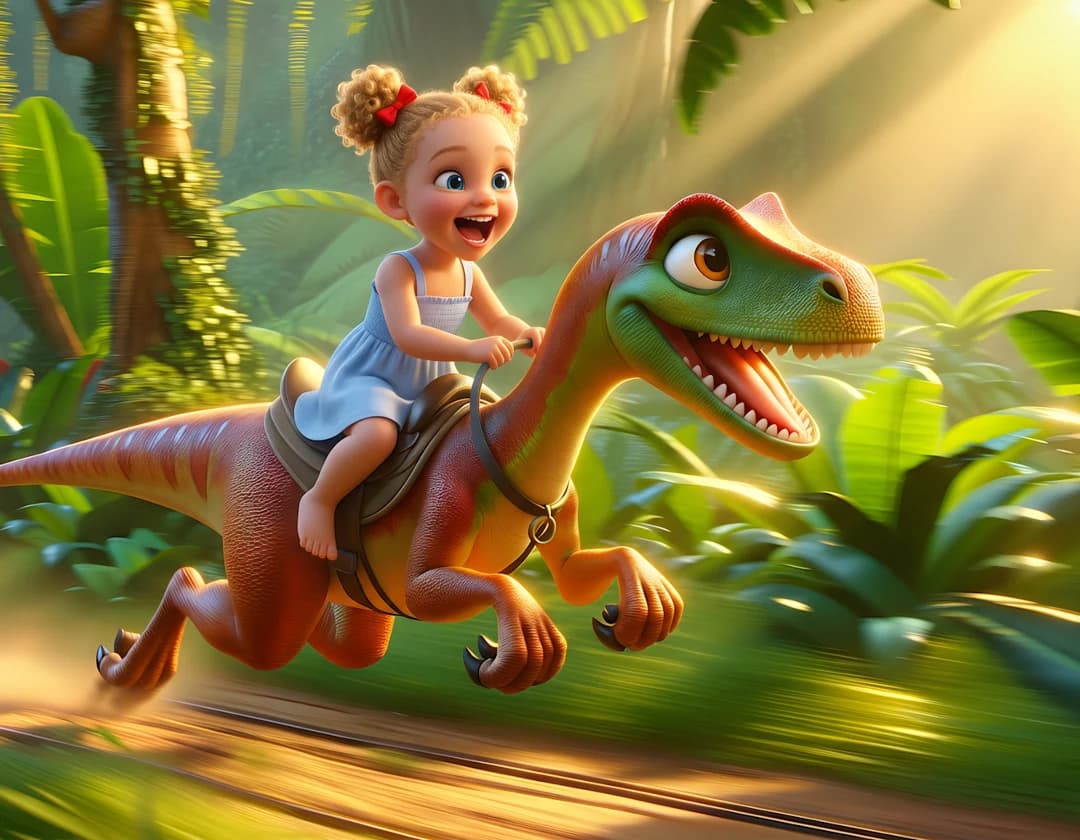
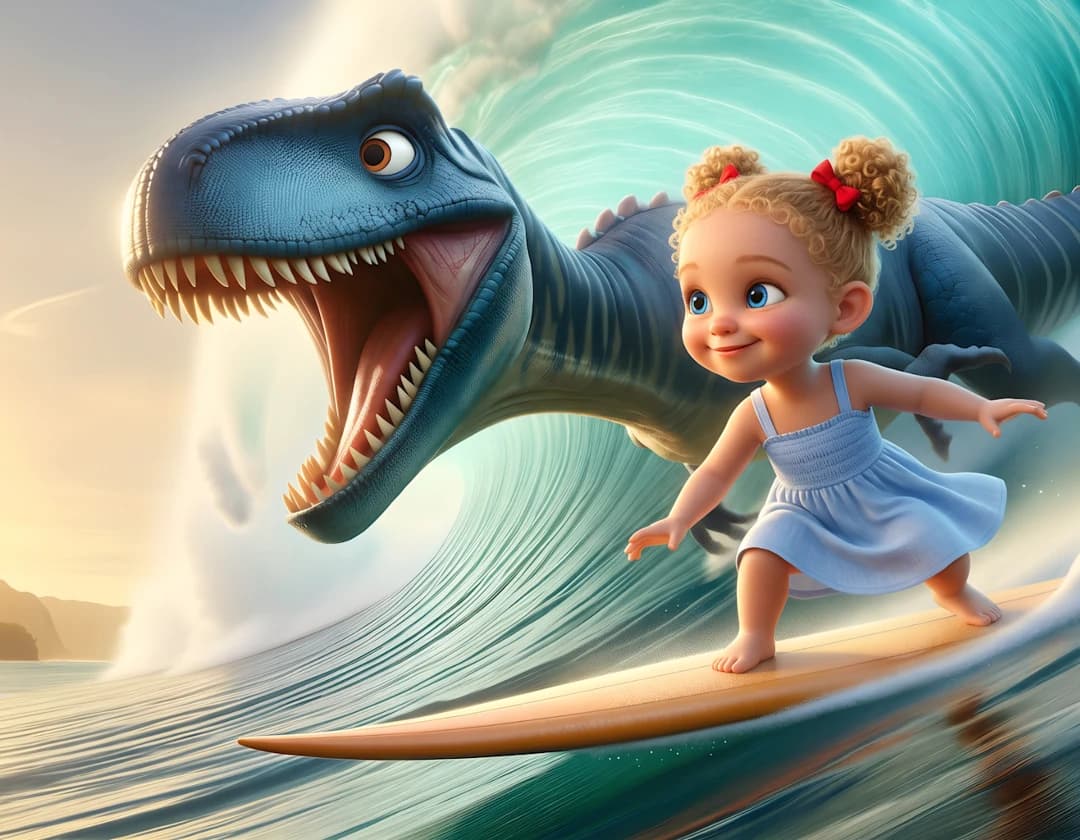
Here's what that looks like in a real book. You Should Never Play Tennis With a T-Rex is twelve sports against twelve prehistoric opponents, most of them a bad matchup for a reason your child can see. A T-Rex's arms are too short for tennis. A Velociraptor will win any race, so your child asks for a ride instead.
For a child who's done after two pages, that shape matters. Every matchup is its own joke with its own picture, so two pages is a complete, funny reading session. So is all twelve. It also asks to be acted out: serve like a T-Rex, run like a Velociraptor, then come back for the next page.
-
One page, one joke You can't outrun a Velociraptor, so take a ride.
-
A picture that carries the story Pages show the book's example child. Your copy shows yours.
That's one example. Start from whatever your child can't stop talking about:
| If your child is all about... | Try | In the story, your child... |
|---|---|---|
| Dinosaurs and jokes | You Should Never Play Tennis With a T-Rex | Takes on twelve sports against twelve prehistoric opponents |
| Superheroes | The Defender series | Earns the Defender Suit and cape, then faces villains such as Picky Eater, Tantrum Man and TV Man |
| Video games | Next Ready series (ages 4 to 10) | Plays through four arcade-style adventures with a grown-up of your choice as Player 2 |
| Sports | The Magic Baseball | Heads to Little League practice with a talking baseball named Homer |
| Animals and bedtime | Even Whales Go to Bed | Searches for an animal that never sleeps, until a gentle whale explains why everyone rests |
These are stories, not programs. You can look inside finished books before you choose, or browse all our books.
How to read it with a child who can't sit still
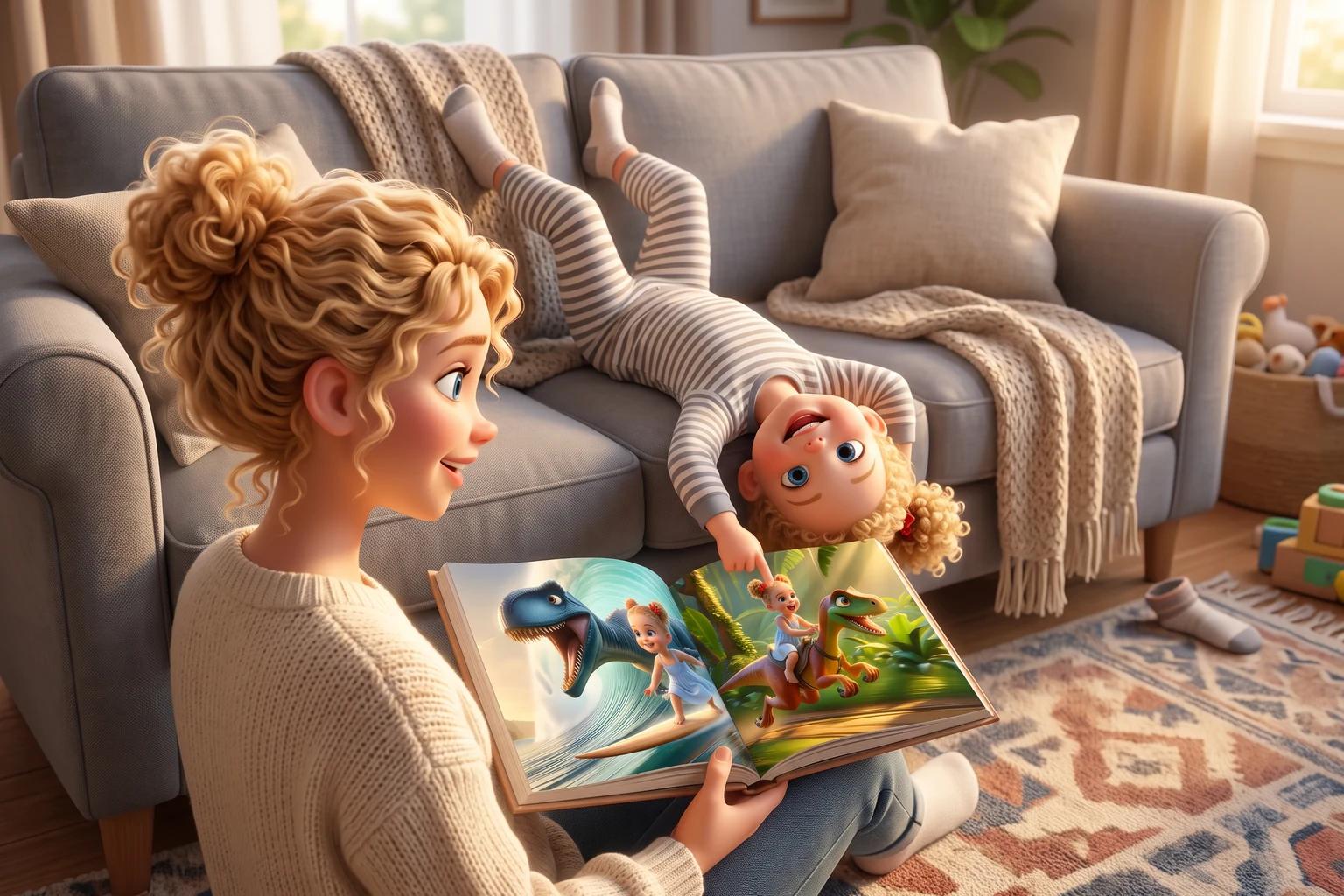
The American Academy of Pediatrics publishes tips for sharing books with children who have special health and developmental needs, including children who are very active, have short attention spans or have ADHD. For toddlers, it suggests breaking up reading with play, and reading on for a few minutes after your child's attention moves to something else. Its reason is worth remembering:
Your child may be listening while playing.
For preschool and school-aged children, it suggests reading somewhere quiet, with screens off.
The CDC's tips for parents of children with ADHD aren't about books, but three carry over well: keep daily things on the same schedule, break big tasks into shorter steps, and remember that some children with ADHD learn well while they're moving, so watch your child and see what works.
Put together, that looks like this:
| What you notice | What to try |
|---|---|
| They're off the couch by page two | Keep reading for a minute or two. Let them listen from the floor, upside down or mid-somersault. |
| They flip ahead to one favorite page | Go there. Read it, then offer the page before it. |
| They interrupt with a story of their own | That's joining in. Answer, then find your place again. |
| They want the same book every night | Say yes. A favorite is a good thing to have. |
| They're done after three pages | Stop there on purpose. Three pages is a reading session. |
| The pictures hold them but the words don't | Tell the story from the pictures in your own words, in shorter sentences. |
| The words themselves are the hard part | Ask their teacher, and keep reading aloud for fun. |
Give their hands a job. Let them turn the pages, hold a toy that's in the story, or find themselves in each picture.
Same time, same spot. A small routine, like a story after a snack or before lights out, makes reading easier to begin. Our bedtime reading routine guide has simple ideas, and these ways to make story time interactive need no props.
Don't make stillness the price of a story. The AAP and CDC tips above already point that way. One lab study adds a footnote: 29 boys with ADHD, aged 8 to 12, did better on memory tasks when they were moving more, though still not as well as the boys without ADHD (Sarver and colleagues, 2015). The movement didn't change how attentive they were, and the study wasn't about reading.
If your child is autistic, has ADHD, or both
You know your child far better than any book company does. A few things worth knowing before you order:
- Seeing themselves can be thrilling, or strange. Some kids love it at once. Others need a minute with a new picture of themselves. Make the free preview first and watch their face. If the character doesn't look right, you can make a new one before you buy.
- Take away the surprises. The CDC lists getting upset by small changes and needing to follow certain routines among the possible signs of autism, and notes that a child may show some, all or none of them. If yours likes to know what's coming, look inside the book yourself first, tell them how the story ends, and say how many pages you'll read tonight.
- The book is a quiet object. It's a printed hardcover: no screen, no sounds, no lights. Your child sets the pace by turning the page, or by closing the book.
- We don't keep your photo. We don't save the original photo you upload, and we don't use customer photos or characters to train AI. The details are in is my child's photo safe?
- Ask the people who know them. If attention, reading or sensory needs are a real worry, talk with your child's teacher or care team about what support fits. A storybook can sit alongside that support. It can't replace it.
What a book can't do
A story where your child is the hero can give them more reasons to stay with a book. It isn't a treatment, a learning program or a reading intervention, and we haven't studied whether our books change attention, behavior or reading skills. The research above is about young children in general, shared reading, or personalized books in small studies. None of it tested Magic Story books.
Enjoying a story is also different from learning to read one. If your child loves being read to but finds the words themselves hard, that's a question for their teacher. Our guides to raising a confident reader and what to do when a child says they hate reading cover how to keep stories fun while skills get proper support.
And some kids simply won't care for it. That's worth knowing too.
See your child as the hero before you spend anything
- Pick a story about something they already love. The table above is a start.
- Add one photo and their name. You'll see a free personalized preview of your child in a scene or on a cover from that book. No account or credit card is needed. Here's how the free preview works.
- Watch their reaction instead of asking for a verdict. Do they point, name themselves, ask to see it again, or look away?
- Read a couple of pages aloud. The preview isn't every page, so look inside the book for the story itself.
- Trust what you saw. A child who lights up has told you something. So has a child who shrugs.
In the US, most books are $44.99 as a one-time hardcover, or $24.99 a month with a Magic Story+ membership. Prices can differ by book, offer and shopping country, shipping and tax are added at checkout, and checkout shows your total before you pay. Each book is printed for your child; in the US, printing takes 3 to 5 business days before shipping.
Browse all our books and pick the story your child would want to be in. A good result isn't a child who sat still for every page. It's a few minutes on the rug where they point at themselves and ask what happens next.
Sources
- American Academy of Pediatrics, HealthyChildren.org: sharing books with children who have special health and developmental needs
- American Academy of Pediatrics policy statement on literacy promotion (2024)
- CDC: parent training in behavior management for ADHD, with tips for parents
- CDC: signs and symptoms of autism spectrum disorder
- Andrews, Murphy and Dunbar (2020): the self-reference effect in young children's memory
- Dong, Chow, Mo and Zheng (2023): dialogic reading with kindergarteners who have ADHD
- Sarver and colleagues (2015): movement and working memory in boys with ADHD
- Horst, Parsons and Bryan (2011): repeated storybooks and word learning
- Kucirkova, Messer and Whitelock: parents reading personalized books with toddlers
- Kucirkova, Messer and Sheehy (2014): personalized books and word learning in preschoolers
Questions parents ask
Are Magic Story books made for kids with ADHD?
No. They weren't designed for ADHD, and they don't treat, manage or improve ADHD, autism or any other condition. They're personalized picture books for children ages 2 to 10. What they do have are features that can make a story easier to stay with: your child is the hero, every story page is a full-color illustration, the story comes in short scenes, and a grown-up reads it alongside. Every child is different.
Why might a child who struggles to focus stay with a personalized book?
A book about your child gives them a reason to look. In a 2020 study of 138 four- to six-year-olds, children remembered objects better when they were shown beside a photo of their own face than beside another child's, which the researchers read as a child's own face capturing attention. Small studies of personalized books have also found more smiles and laughter, and better learning of words from personalized sections. None of those studies tested Magic Story books or children with ADHD.
Is there research on reading with children who have ADHD?
Some. For very active toddlers, the American Academy of Pediatrics suggests breaking up reading with play and reading on for a few minutes after their attention shifts, because they may still be listening. In a randomized trial of 850 kindergarteners with ADHD in China, 12 weeks of dialogic reading, a back-and-forth way of reading, with a parent or older sibling improved language skills and interest in reading; the comparison groups also read with family, without that method. Nobody has studied Magic Story books with children who have ADHD.
My child is autistic and has ADHD. Is a Magic Story book a good fit?
It might be, and you know your child best. Some kids love seeing themselves in a story; others need time with a new picture of themselves. Make the free preview together, look inside the book first, and tell your child what happens in the story if they like to know what's coming. Read at their pace: it's fine to stop early, skip ahead, repeat a page or move around.
Is it OK if my child doesn't sit still while we read?
Yes. A child doesn't need to sit still, stay quiet or answer questions to enjoy a story. In its tips for reading with very active toddlers, the American Academy of Pediatrics notes that a child may be listening while playing. Let the book follow them to the floor or the couch, keep sessions short, and stop while it's still fun.
Which Magic Story book should I start with?
Start with what your child already can't stop talking about. For dinosaurs and jokes, You Should Never Play Tennis With a T-Rex is twelve short, funny matchups, so even two pages make a complete reading session. There are also superhero, video game, sports, big feelings and bedtime stories. You can look inside finished books and make a free preview before you choose.


