How to Help Kids With Anxiety at Bedtime: What Actually Works (And What the Science Says)

Magic Story
10 min read | March 2, 2026

How to Help Kids With Anxiety at Bedtime: What Actually Works (And What the Science Says)
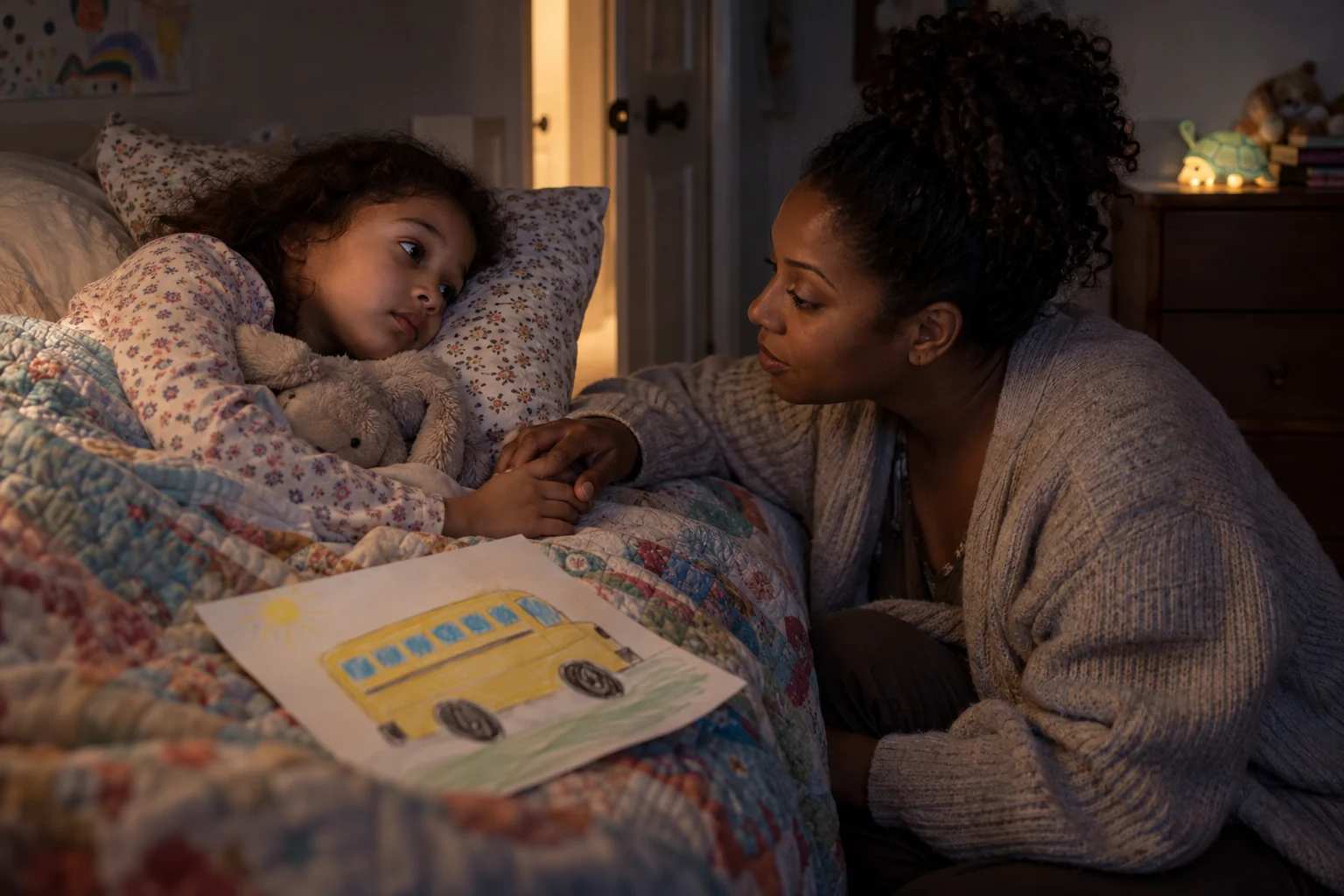
Sofia was six when the nighttime battles began. Every evening at 8 p.m., her mom Sarah would tuck her in, kiss her forehead, and head toward the door, only to hear the familiar cry: "Mom, wait! There's something in the closet." Sarah would return, check behind the door, reassure her, and leave again, only for the cycle to repeat five more times. By 9:30 p.m., both were exhausted, frustrated, and trapped in an anxiety loop that left them both dreading bedtime. Sarah tried everything: nightlights, longer routines, promises of reward charts. Nothing stuck. Then one evening, Sarah created a simple personalized bedtime story where Sofia was the brave hero who befriended her fears. She read it every night for a week. By day ten, Sofia asked to hear the story. By week three, she was the one turning off the light. The change wasn't magical, but it felt that way to a desperate parent. The real magic was in giving her mind a new narrative.If you're a parent reading this at 10 p.m. because your child still hasn't fallen asleep, you're not alone. Bedtime anxiety in children has become so common that pediatricians and child psychologists now consider it one of the most frequent concerns parents bring to their offices. The American Academy of Pediatrics reports that sleep issues affect up to 30% of children, with anxiety playing a significant role in many of those cases. What makes this worse is the isolation many parents feel: you're standing in a darkened doorway, exhausted, while your child cries about monsters, fears the dark, or simply can't quiet their mind.
The thing about bedtime anxiety is that it's not a flaw in your parenting or your child's character. It's a neurological reality. As daylight fades and demands quiet down, kids' brains shift into a different gear, one where anxious thoughts have room to flourish and imaginations run wild. The skills and coping tools that work beautifully during the day somehow evaporate the moment the lights go off. Understanding why this happens, and then knowing what actually works to help, can transform not just bedtime, but your entire family's relationship with sleep and rest.
Looking for a bedtime book your child will actually ask for?
Explore All Magic Story Books →Why Bedtime Is the Hardest Time for Anxious Kids
To understand why bedtime anxiety feels so much more intense than afternoon worry, you have to understand what's happening in your child's brain as the sun sets.
During the day, your child's prefrontal cortex is online. This is the part of the brain responsible for logic, reason, emotional regulation, and problem-solving. It's the part that can hear you say "there's nothing in the closet" and believe you. It's the part that can use coping tools, ask for help, and rationalize that danger isn't present. It's the boss of the brain.
But as bedtime approaches and your child's body readies for sleep, the prefrontal cortex begins to dial down. Meanwhile, the amygdala, the brain's alarm system and fear center, becomes more active. This isn't a design flaw; it's evolution. When our ancestors lay down to sleep in a dark cave, we needed our threat-detection systems on high alert. That's the amygdala's job. Your child's ancient brain still carries this programming.
Combine this neurological shift with the fact that bedtime removes all external distractions and coping tools (no toys to hold, no siblings to talk to, no activities to focus on), and you have the perfect storm for anxiety. The mind has space. The logical brain has dimmed. The threat-detection system is running. And suddenly, shadows on the wall become monsters, normal house sounds become intruders, and the idea of closing their eyes feels dangerous.
This is not a choice your child is making. It's not manipulation or stubbornness, though exhausted parents sometimes wonder. It's neurology. And once you understand that, everything shifts.
Looking for a bedtime book your child will actually ask for?
Explore All Magic Story Books →What the Research Says About Helping Kids With Anxiety at Bedtime
The research on childhood bedtime anxiety points to several evidence-based strategies that actually move the needle. Let's talk about what works.
Consistent routines are not just nice to have; they're neurologically powerful. When your child knows exactly what comes next, their brain can relax slightly. Predictability itself is calming. The amygdala responds to the known and the unknown differently, and a consistent bedtime routine creates a sense of safety through familiarity.
Co-regulation is the clinical term for what you're doing when you sit with your anxious child and help calm their nervous system with your own. Your calm voice, your steady breathing, your presence, your predictable responses, all of these influence your child's physiology. When your child sees you're not alarmed by the closet shadows, their body learns that this isn't a threat. This is not coddling; this is neuroscience. The parent's regulated nervous system literally helps regulate the child's.
Reading together is perhaps one of the most underrated bedtime anxiety tools. Here's what happens in the brain when you read a story to your child: First, the repetition and rhythm of reading activates the parasympathetic nervous system, the "rest and digest" branch. This naturally calms the amygdala. Second, stories engage the narrative processing systems in the brain. When your child follows a story with a beginning, middle, and end, their brain is processing emotional arcs, character development, and problem-solving. This occupies the prefrontal cortex just enough to quiet the background noise of anxiety. Third, reading a story about a character facing and overcoming fears provides what psychologists call "narrative modeling." Your child sees someone else (or in the most powerful case, themselves) facing darkness, monsters, or nighttime and finding it's manageable. The brain begins to rewire what's possible.
Looking for a bedtime book your child will actually ask for?
Explore All Magic Story Books →The Bedtime Routine Strategies That Actually Help
Let's talk about the practical strategies you can implement tonight.
Consistent timing matters more than you'd think. Pick a bedtime and stick to it, even on weekends if possible. Your child's circadian rhythms will align, and the body will begin naturally preparing for sleep. Consistency also means your child knows what to expect, which is grounding for an anxious mind.
Create a clear wind-down sequence. About 30 to 60 minutes before bed, begin transitioning from active play to calm activities. This might look like: bath time, putting on pajamas, a light snack (avoid sugar), then screen-free time with dim lighting. The sequence itself signals to the body that sleep is coming.
Eliminate screens at least one hour before bed. The blue light from devices suppresses melatonin production, yes, but more importantly, screens keep the prefrontal cortex engaged and stimulated. You need this part of the brain to relax for sleep to come easily. For an anxious child, screen stimulation right before bed is particularly counterproductive.
Use sensory cues to create a calming environment. Dim the lights, use soft blankets, perhaps add a white noise machine or a salt lamp with warm light. Sensory inputs signal safety to the nervous system. Some kids respond beautifully to weighted blankets. Others prefer a small stuffed animal to hold. Pay attention to what settles your particular child.
Teach simple breathing techniques. The "box breathing" method is especially helpful for anxious kids: breathe in for four counts, hold for four, exhale for four, hold for four, repeat. This conscious slowing of breath directly activates the parasympathetic nervous system. Teach this during the day, so your child can access it when needed at night.
For older kids (ages seven and up), try the worry journal approach. Before bed, give your child a notebook and ask them to write or draw all the worries they're holding. This externalizes the anxious thoughts, getting them out of the head and onto paper. Then you physically "close" the journal, symbolically containing the worries until morning. This often provides surprising relief.
Looking for a bedtime book your child will actually ask for?
Explore All Magic Story Books →Why Stories Are One of the Most Powerful Bedtime Anxiety Tools
Among all the strategies that help with bedtime anxiety, there's something uniquely powerful about stories.
Here's why: anxiety lives in uncertainty and endless loops. Your child's mind, when anxious, fixates on a fear without resolution. Will the dark get me? What if there's something under the bed? These thoughts spiral without beginning or end. But a story has structure. It has a beginning (character introduced), a middle (problem arises), and a resolution (problem solved). Stories give the mind what it desperately needs: an arc, a containment, a sense of completion.
Stories also work through character identification. When a character in a story faces darkness or fear and moves through it, your child's brain is processing that possibility. "If the character can do it, maybe I can too." This is not wishful thinking; this is how narrative exposure works in therapeutic settings.
But there's something even more powerful: when the character in the story is your child.
Personalized stories take all of this and amplify it. When your child sees their own name as the brave hero, their own characteristics as strengths, and their own bedtime as an adventure they can navigate, something shifts. Anxiety thrives when your child sees themselves as helpless or broken. Stories where they are the hero fundamentally contradict that narrative.
There's No Such Thing as Monsters is designed exactly for this. In this personalized book, your child confronts the very fears that keep them awake, but not as a victim. They're the protagonist who discovers that what scared them is not what they thought it was.
Me and Spark Aren't Afraid of the Dark takes a different approach: companionship. For many anxious kids, the fear isn't really about monsters; it's about being alone in the dark. This story introduces Spark, a lovable companion who stays with your child through the darkness, making it feel less isolating and more like an adventure shared with a friend.
Even Whales Go to Bed works differently still. Instead of confronting fear directly, it normalizes bedtime through nature. If whales, who are massive and powerful creatures, go to bed, then your child is participating in something natural and universal, not something scary or abnormal. This reframing is subtle but powerful for kids whose anxiety is rooted in resistance to bedtime itself.
The science supports this. Research on narrative therapy shows that stories about facing fears before bedtime can reduce both anxiety and the time it takes to fall asleep. When you pair this with the fact that these stories are personalized, including your child's name and details, you're creating something even more potent: a nightly tool that tells your child's brain, "You are safe. You are brave. You belong here."
Frequently Asked Questions About Bedtime Anxiety in Kids
At what age does bedtime anxiety typically start?
Bedtime anxiety can emerge as early as age two, often around the time separation anxiety develops. However, it tends to peak between ages four and eight, when imagination is flourishing but logic is still developing. Some kids experience it later, around ages nine to twelve, often tied to increasing stress or life changes. The good news is that the strategies that help work across a wide age range.
Is bedtime anxiety in kids normal?
Yes, absolutely. Some level of bedtime resistance or anxiety is developmentally normal. However, there's a difference between a child asking for one extra hug and a child who is unable to fall asleep without a parent in the room for hours, or who is experiencing genuine panic. If bedtime anxiety is significantly impacting your child's sleep quality or your family's wellbeing, it's worth addressing proactively rather than waiting for them to "grow out of it."
When should I consider seeking professional help?
If your child's bedtime anxiety persists despite consistent efforts to help, or if it's accompanied by other signs of anxiety like perfectionism, excessive worry during the day, panic symptoms, or social withdrawal, a conversation with your pediatrician or child psychologist is appropriate. These professionals can rule out underlying issues and offer additional tools like cognitive behavioral therapy, which is highly effective for anxiety in children.
How long should a bedtime routine actually be?
Research suggests that 30 to 60 minutes is optimal. Too short and the transition from active play to sleep is abrupt. Too long and it can become a source of stress itself. The key is consistency; your child's nervous system will calibrate to the routine itself, so it matters less whether it's 30 or 45 minutes than that it's the same every night.
Is melatonin safe for kids with bedtime anxiety?
Melatonin can be helpful for some children, but it's not a first-line treatment for anxiety-based sleep issues. Melatonin helps regulate circadian rhythms, but if anxiety is the primary problem keeping your child awake, melatonin won't address the root issue. Talk with your pediatrician about whether melatonin is appropriate for your child and at what dose. Behavioral strategies and stories almost always should be tried first.
Key Takeaways
- Bedtime anxiety in children is rooted in neurobiology, not behavior. The prefrontal cortex naturally quiets at night while the threat-detection amygdala activates.
- Consistent routines, co-regulation, and reading are evidence-based strategies that work by calming the nervous system and engaging the logical brain.
- Stories are uniquely powerful for bedtime anxiety because they provide structure, model courage, and help children process fears safely.
- Personalized stories where your child is the hero amplify the benefits by directly contradicting the anxiety narrative.
- The most effective approach combines multiple strategies: a consistent routine, a calm environment, breathing techniques, and a meaningful bedtime story.
- Bedtime anxiety is developmentally normal, but persistent anxiety warrants conversation with your pediatrician.
The journey from dread to peace at bedtime doesn't happen overnight. But it does happen, especially when you work with your child's neurobiology rather than against it. You're not trying to eliminate all anxiety; you're helping your child develop the tools to move through it. You're teaching their brain that night is safe. That they are brave. That they can rest.
Every night you read a story together, you're literally rewiring your child's response to bedtime. Every time you sit calmly with their fear instead of dismissing it, you're teaching co-regulation. Every time your child falls asleep more easily, their nervous system is recalibrating what's possible.
Magic Story books exist because so many parents have discovered what researchers confirm: stories are one of the most powerful tools we have for helping kids navigate anxiety. When your child sees themselves as brave in a bedtime book night after night, something shifts in how they approach their actual bedtime. The story becomes a mirror that shows them who they already are.
Create a personalized bedtime book for your child today
Give them a story where they're brave, safe, and the hero of the night.
Start Here →