Best Personalized Books for 6-Year-Olds: 5 Picks That Make Kids the Star
Discover the best personalized books for 6-year-olds: expert picks that spark curiosity about history, science, and emotions where your child is the hero.

10 min read | February 11, 2026 · Updated August 27, 2026

Micah used to hand you the book, climb into your lap, and wait. Now he grabs it off the shelf, flops onto the floor, and says, "I'll read the first page." He gets stuck on "unbelievable," sounds it out in three pieces — un, believe, able — gets it, and looks up at you like he just won something. That's six in a single moment: decoding a hard word, feeling proud of it, and wanting you to see it happen.
Something else is happening alongside the decoding. Six-year-olds are asking bigger questions than they used to: "Why do people have different skin colors?" "What happened before I was born?" "Is it okay to feel angry?" Their moral compass is getting more sophisticated, and they're starting to care about fairness in a new, almost fierce way. (If you're coming from the stage just before this one, our guide to the best personalized books for 5-year-olds covers what changes in that single year.)
And through all of it, they still want to be the hero of the story. At six, that's not just cute — it's well-timed developmentally. A child who's newly capable of decoding real sentences and newly curious about the wider world is exactly the child who benefits most from being the one who solves the mystery, crosses the timeline, or names the feeling.
What Changes When a 6-Year-Old Starts Reading to You?
Somewhere around six, the balance flips: your child stops being only a listener and starts being a reader who occasionally lets you listen to them instead. That single shift changes what a book needs to do — it has to reward the effort of sounding words out, not just hold their attention while you read.
Decoding Real Sentences, Not Just Recognizing Words
Your child can now handle multi-scene plots, characters with real motivations, and text that doesn't resolve in five pages. They don't need a story that stays simple to stay accessible — they need one worth the effort of sounding out.
Confidence That Comes From Finishing, Not Just Trying
Sixes care a lot about what they can do. A book where their character is the one solving the problem, being brave, or being kind gives them proof, not just praise — and proof is what keeps a beginning reader coming back to the page.
Curiosity About How the World Actually Works
This is the age of "but why." History, weather, how different people celebrate — a story that teaches something real feels genuinely interesting at six, not preachy, especially when your child is the one doing the discovering.
Emotional Complexity That Feels Safe, Not Overwhelming
Six-year-olds are starting to understand that feelings are complicated — sadness, jealousy, and pride can show up together. Books that let Big Feelings get named and worked through, without ignoring them or making them scary, meet kids exactly where they are.
The 5 Books Built for This Reading Leap
| Book | Theme | Why This Age |
|---|---|---|
| Tumble Through Time | History adventure | A multi-era plot rewards a reader who can now follow a longer story |
| The Dream Carriers | Identity & legacy | Meets a growing sense of fairness and belonging with real stakes |
| Where Does the Rain Go? | Water-cycle science | Turns "but why" questions into a discovery your child narrates themselves |
| The Emotion Emporium | Emotional vocabulary | Names complex feelings a six-year-old is only starting to recognize |
| The Magic Baseball | Confidence & courage | Rewards persistence — the same skill that's carrying their reading |
Tumble Through Time
This is the book for the kid who's asking "but when?" constantly. Tumble Through Time puts your child at the center of a historical adventure where they're traveling through different eras, meeting people from the past, and discovering how the world got to be the way it is.
What makes this special for six-year-olds is that it doesn't feel like a lesson. Your child is an adventurer, not a student. It's also a genuine decoding stretch — longer scenes, more names, more cause-and-effect — which is exactly the kind of text a newly confident reader is ready to take on.
The personalization here is subtle but powerful: your child is the one connecting these stories, seeing the threads that link past to present. At six, sticking with a harder book to find out what happens next feels like a superpower.
The Dream Carriers

If your child is starting to ask questions about fairness, identity, and history — especially as they're learning about different cultures and traditions — The Dream Carriers is going to resonate deeply.
This book centers your child's story within a larger, more beautiful narrative about Black history and possibility. It's not heavy-handed. It's hopeful and personal and teaches kids that they are part of a story larger than themselves. For six-year-olds who are developing a sense of justice and belonging, this is genuinely transformative.
What we love most: six-year-olds can understand the concept of dreams and possibility in a new way at this age. They can see themselves as carrying something forward. It makes them feel important in a real, meaningful way — not because they're the protagonist of an adventure, but because they're part of something that matters.
Where Does the Rain Go?

Your six-year-old is definitely in a "why" phase. Not the toddler "why why why" that's mostly just delightful chaos — but real, genuine curiosity about how the world works.
Where Does the Rain Go? teaches water cycle science, but it does it through a story where your child is the one discovering where rain goes, why it matters, and how everything is connected — you can read more about how this story turns rainy days into adventures in our full guide. For a six-year-old, understanding that rain doesn't just disappear — that it becomes rivers, that it gets used by plants, that it comes back again — is genuinely mind-blowing.
At this age, kids are moving from concrete thinking ("the rain is wet") to starting to understand systems and cycles. A personalized book that makes your child the scientist, the explorer, the one asking the questions, builds confidence in their own ability to understand the world — and in their ability to read their way to the answer.
The Emotion Emporium

Here's something real: six-year-olds feel a lot more than they can usually express. They have emotions that surprise them — envy, indignation, complicated sadness alongside joy. Often, they think these feelings are weird or wrong.
The Emotion Emporium is a personalized story where your child is exploring a place full of different feelings, learning that all emotions are normal, and discovering healthy ways to understand what they're experiencing. It's not preachy. It's an actual adventure through a magical place where feelings are real and worth understanding.
What matters developmentally: six-year-olds are starting to develop emotional vocabulary. They can now think about feelings not just as happening to them but as things they can recognize and name. Your six-year-old will read this and think, "Oh, so other people feel confused too. So feeling angry doesn't make me bad." That's big stuff.
The Magic Baseball

This one's for confidence-building and the emerging sense that you can do hard things.
The Magic Baseball is a story about your child discovering they have courage, skill, and the ability to grow. It's not just about sports — it's about trying something challenging, feeling nervous, and then discovering you're capable of more than you thought. That's the same muscle a beginning reader uses every time they stick with a hard sentence instead of giving up on it.
Six-year-olds are at a really interesting developmental stage for this. They're starting school sports, or other activities where performance matters, and they're aware they're not always perfect at things. A personalized book where your child is the one who's brave, who practices, who discovers their own capability, becomes part of their internal narrative about who they are — on the page and off it.
Does Personalization Actually Help Kids Decode and Stick With a Book?
Largely yes, and mostly because it changes how much effort a beginning reader is willing to spend. A six-year-old on the fence about reading works harder to sound out a hard word when the payoff is watching themselves solve the mystery, not a stranger. That extra effort is what turns decoding practice into a habit.
Reading Motivation: A six-year-old who's struggling to see reading as something for them will suddenly care intensely when they see themselves in the story. Research on the self-reference effect — the well-documented finding that children encode and recall self-relevant information more effectively than generic information — suggests personalization may give early readers a genuine memory and motivation edge, not just an emotional one (Cunningham et al., Child Development, 2014).
Identity Formation: Six-year-olds are starting to understand themselves as individuals — what they like, what they're good at, who they are. A personalized story where they're the hero sends a clear message: "You are someone interesting, and your story matters." That's not small.
Emotional Processing: Reading a personalized story where your child's character experiences a feeling — fear, jealousy, sadness, joy — and works through it creates a kind of safe space for processing their own emotions. It's less threatening than a therapist saying "let's talk about your feelings," and more natural. They're seeing themselves successfully navigate emotional terrain.
Memory and Retention: A child who reads a personalized story about the water cycle will remember it differently than a child who reads a generic water cycle book. They'll remember it as their story — the time they traveled through the water cycle and discovered something amazing. That extra hook is what brings them back to reread it.
Confidence in Complex Thinking: When a six-year-old reads a personalized book with real plot complexity, history, science, or emotional depth, they're reading the book and simultaneously thinking, "I understood this. I can understand big ideas. I'm the kind of person who learns." That's identity stuff. That's foundational.
How to Make "Reading to You" Time Feel Like a Win
Let them sound it out: Resist the urge to jump in the second they hesitate on a word. Give them a few seconds. The moment they crack a hard word on their own is the moment they decide reading is something they're good at.
Celebrate the finish, not just the fluency: It's tempting to correct every mispronunciation. Save your corrections for words that change the meaning, and let the small stuff go. A six-year-old who finishes a page feeling capable will pick the book back up tomorrow.
Read it again when they ask: Six-year-olds often return to a familiar story for the pleasure of being its protagonist again. On a reread, pause for new details or ask what the character could try next.
Use it for conversations: If the book touches on emotions, history, or science, use it as a springboard. "Remember in the story when your character felt scared? Have you ever felt that way?" These conversations help kids integrate what they've learned.
Make it a special ritual: A personalized book is a gift. Treat it like one — a bedtime tradition, or a weekly read-together on Sunday. The ritual around it matters; it says to your child, "This matters, and so do you."
Let them own it: If your six-year-old wants to read it independently, let them. Yes, you could read it to them, but the pride of reading their story themselves is something else entirely. When they're ready for the next stage, our guide to the best personalized books for 7-year-olds picks up where this one leaves off.
Frequently Asked Questions
Will a personalized book be too advanced for my 6-year-old who's still decoding words?
No — that's exactly who these books are built for. The personalization is what makes a slightly harder word worth sounding out: kids push through a tricky sentence when the payoff is watching themselves solve the mystery. These books also work beautifully as read-alouds, so you can share the experience together until your child is ready to read independently.
Can I use a personalized book to help my 6-year-old with a specific issue like big feelings or fairness?
Yes. The Emotion Emporium is built specifically to help kids name and understand feelings that confuse them, and a personalized version is more powerful because your child sees themselves working through it, not a stranger. A book isn't a substitute for your patience and support — it's a tool that works alongside your parenting.
How do the illustrations work? Will my child actually feel like they see themselves?
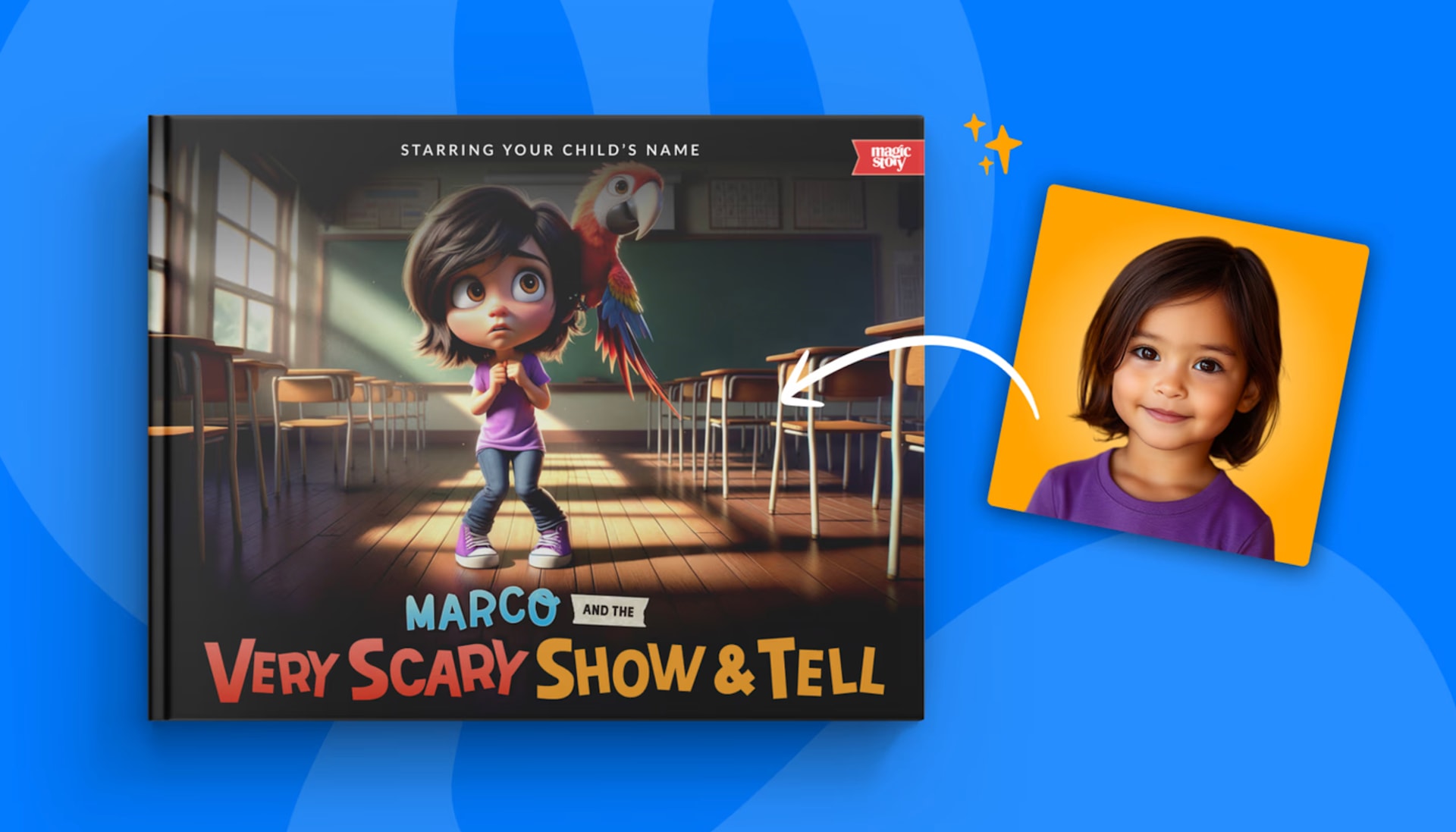
Magic Story uses Pixar-quality AI illustrations with photo-quality personalized avatars. Your child will genuinely see themselves in the story — not a generic character with their name inserted, but them as the protagonist. Parents often describe the moment their child first sees themselves as emotional and a little magical.
Are these books only for kids who already love reading?
No — they're often most useful for kids who don't love reading yet. Seeing themselves as the protagonist creates investment that a generic book can't. Reluctant readers frequently want to sit down with a book once it's their own story, with them as the hero.
Can my two children share one personalized book?
You could, but the magic is in the personalization. If each child has their own book where they're the protagonist, that's where the real value is. You're not just getting a book — you're giving each child a story that belongs to them.
Are these books a good gift for kids who don't live with me?
Yes — cousins, godchildren, students, friends. A personalized book is a gift that says, I see you, I think your story is important, I want you to see yourself as the hero. That's meaningful coming from anyone.
How much do these personalized books cost?
A single hardcover is $44.99 USD. If you'd rather build out a small library over the year, Magic Story+ delivers a new personalized book every month for $24.99 USD. These are US prices; check the product page for pricing in your shopping country.