Best Personalized Books for 5-Year-Olds: 5 Picks That Make Kids the Star
Discover the best personalized books for 5-year-olds: expert picks that build confidence, curiosity, and emotional skills where your child is the hero.

11 min read | February 17, 2026 · Updated August 27, 2026
Your five-year-old woke up nervous about their first day of kindergarten. They'd met the teacher once, at a field trip, and knew exactly one kid in the class. By breakfast, they'd cycled through at least four emotions — anxiety, excitement, bravery, doubt. They asked seventeen questions about the logistics of the day, insisted on wearing their lucky shirt, then went quiet and contemplative on the car ride, visibly preparing for something big.
This is five.
Five-year-olds are standing at the threshold of something significant, moving from the preschool world into elementary school, where expectations shift and their world gets bigger in concrete ways — a leap our guide to the best personalized books for 6-year-olds picks up right where this one leaves off. If your child is still settling into preschool routines, our guide to the best personalized books for 4-year-olds covers that earlier stage. Personalized books for five-year-olds should honor this growing complexity. They should celebrate independence while acknowledging the very real anxiety that comes with new challenges, fuel curiosity about how things work, and affirm that their child is capable, brave, and good.
Why Turning Five Feels Like Such a Big Deal
Something concrete changes in a five-year-old's mind around this age, and it explains a lot of what's happening at breakfast, on the playground, and at bedtime.
Theory of Mind, More Fully Formed
Between three and five, children go through what researchers call the "great shift" in theory of mind — the growing understanding that other people have their own thoughts, wants, and feelings, separate from their own. By five, that understanding is more solid than it was at four, which is exactly what makes real empathy possible: your child isn't just reacting to how someone else feels, they're starting to genuinely model it.
Moral Reasoning Is Starting for Real
That same shift shows up as an emerging sense of fairness. Five-year-olds notice injustice. They think about kindness and meanness, not just because a parent said so, but because they're beginning to reason about it themselves — an early, real form of moral thinking rather than rule-following.
Curiosity Gets More Ambitious
Five-year-olds want to know how things actually work — the moon, weather, the mechanics of the physical world — and they're ready for answers that go a little deeper than "because."
Humor Requires More From Them Now
Five-year-olds are developing a more sophisticated sense of humor: wordplay, absurdist twists, jokes that require real comprehension. A joke that lands because they get it feels smarter and more satisfying than one that lands because it's just loud or silly.
They Need to Believe They're Capable
With bigger challenges ahead, five-year-olds need evidence that they can handle things — not just reassurance. Stories where the child character faces something real and gets through it, using their own resourcefulness rather than being rescued, reinforce the competence they're actively trying to build in themselves.
5 Picks for Starting Kindergarten
Every hardcover below is $44.99 USD, or $24.99 USD/month if you subscribe to Magic Story+. Prices shown are for US customers; check the product page for pricing in your shopping country.
| Book | What It's About | Why It Works at 5 |
|---|---|---|
| Zen & the Storm Inside | Learning to calm big feelings with a wise panda | Gives an anxious kid practical tools before a nervous first day |
| The Fizzy Fib | Discovering why honesty feels better than a lie | Meets five's emerging sense of right and wrong without lecturing |
| Where Does the Moon Go? | Following the moon through its phases | Rewards a five-year-old's genuine curiosity about how the world works |
| The Sneeze of Destiny | A small action with a rippling chain of consequences | Shows a child's actions genuinely mattering to others — the root of empathy |
| You Should Never Play Tennis With A T-Rex | An absurd dinosaur sports mishap | Sophisticated, wordplay-driven humor that respects a five-year-old's wit |
Zen & the Storm Inside
Sometimes feelings feel like storms inside. This story introduces your child's character to mindfulness — not as meditation or woo, but as the practical skill of noticing what's happening internally and finding a way to calm down. Big feelings don't have to control them; they can be observed, understood, and managed.

Five-year-olds are often on the edge of school entry, and that comes with real anxiety. The book doesn't dismiss those feelings — it shows your child's character discovering they have some capacity to manage their own emotional experience: noticing a breath, feeling their feet on the ground, paying attention to what they can see and hear. These are tools a five-year-old can actually use, not abstractions.
Pair it with: Two minutes of real, guided breathing together. It turns the book's idea into a tool your child has actually practiced before they need it.
The Fizzy Fib
Everyone lies sometimes, and five-year-olds are becoming aware of dishonesty and its consequences. In this story, your child's character tells a small lie and discovers that honesty — while sometimes harder in the moment — actually feels better and leads to better outcomes. It's not a book about punishment; it's about why honesty matters.

The "fizzy fib" concept makes dishonesty feel observable and manageable rather than shameful, which is exactly the register five-year-olds' still-forming moral reasoning needs — not a verdict, but a way to notice what's happening and choose differently next time.
Pair it with: A calm moment, not the immediate aftermath of a lie. It works better as a conversation starter than as a consequence.
Where Does the Moon Go?
Your five-year-old has probably already asked about the moon — why it looks different, where it goes during the day. This story follows your child's character through the moon's phases, explaining what's actually happening in a way that satisfies both wonder and curiosity.

It isn't a straightforward science lesson — it's an adventure where your child's character follows the moon and uncovers its secrets, with illustrations that convey the actual mechanics visually. That respects both the mystery and the science, rather than replacing one with the other.
Pair it with: An actual moon-watching night. Check the lunar calendar and let your child connect the book to what they see in the sky.
The Sneeze of Destiny
A small action — maybe a sneeze, maybe something your child's character does on purpose — sets off a chain reaction of consequences. Through this playful exploration, your child discovers that their actions have real impact and that considering how their actions affect others is the essence of empathy.

This lands at five specifically because your child's character's actions ripple outward and affect others in a way that's deeply satisfying to understand once theory of mind has taken hold. The lesson arrives through a playful, almost magical lens rather than a heavy-handed one.
Pair it with: A real moment of kindness. When your child does something thoughtful, connect it back: "See how you made a difference, just like your character did?"
You Should Never Play Tennis With A T-Rex
This one is pure fun with some genuine wit underneath it. Your child's character shouldn't play tennis with a T-Rex — for obvious reasons — but the story follows exactly what happens when they do, handling an absurd situation with creativity and confidence.

It's genuinely funny — the sheer absurdity of the setup carries real wordplay and unexpected turns, which is the kind of humor a five-year-old's more sophisticated sense of comedy actually appreciates. Underneath the jokes is a quieter message: you're resourceful enough to handle whatever comes your way, even if it's a dinosaur.
Pair it with: Full silliness. Read it with big voices and let your child riff on how they'd have handled the T-Rex.
Can a Book Actually Calm First-Day Nerves?
A book alone won't erase kindergarten nerves, but it can genuinely help — the same way rehearsal helps with any big, unfamiliar moment. Child development specialists generally recommend familiarizing kids with the new environment ahead of time, keeping routines predictable, and staying visibly calm yourself; a personalized story where your child's own character faces something big and handles it works as a low-stakes rehearsal alongside those strategies, not instead of them.
Personalized books can serve as anchors during a transition like this — reminders that your child is valued and capable even as they enter a genuinely new environment. That message lands harder when your child is the one on the page. Ethical questions in particular — honesty, kindness, empathy — become more impactful when your child is the one making the choice and living with the consequence in the story, rather than watching a stranger do it.
There's a practical upside too: many five-year-olds are beginning to read or are eager to start, and a personalized book is unusually motivating for that. Seeing their own name and image on pages they're learning to sound out gives them a reason to push through text that would otherwise feel hard.
And there's a longer-term payoff most parents don't think about until later: a personalized book from this exact year becomes a kind of time capsule. Years from now, your child might pull a book like this off the shelf and see, in illustrated form, exactly who they were at five — nervous about something big, and brave enough to do it anyway.
Turning Story Time Into Kindergarten Practice
Read With Intention
Choose a moment when you can be fully present. Five-year-olds notice your engagement, and they'll match it — distracted reading gets a distracted listener.
Pause for Real Discussion
Use the story as a springboard: "What would you do in that situation?" or "Why do you think your character made that choice?" These conversations help your child think through their own values, not just follow the plot.
Notice How Their Thinking Is Changing
Pay attention to how your five-year-old interprets characters and consequences. You might catch them developing empathy or reasoning through cause-and-effect in real time — worth naming when you see it.
Let Them Read Along
If your child is beginning to read, invite them to read parts aloud. A personalized book is often motivating enough that a five-year-old will tackle harder text just to read their own name.
Predict Together
Before turning the page, ask what your child thinks happens next. It builds comprehension and gets them actively thinking about character motivation, not just waiting to be told.
Connect the Story to What's Coming
Bridge the book to real life directly: "Remember how your character felt brave even though they were nervous? That's like how you're feeling about kindergarten. You're brave too."
Five-year-olds are standing at the threshold of something significant — kindergarten, more complex friendships, a genuinely new level of self-awareness. Those seventeen breakfast-table questions about the first day of school aren't just nerves; they're a five-year-old doing real work to prepare for something big, in the only way they know how.
Personalized books for five-year-olds do something specific in that moment: they say, "You are ready. You are capable. You are good. And your story matters."
Choose one book that speaks to something your child is currently navigating, or browse our full roundup of the best personalized children's books of 2026 for more inspiration. Notice how they engage with it, and pay attention to the quiet moments — when they're processing something from the book, thinking through a question of right and wrong, or simply feeling seen. Those are the moments that stay with them.
By the time your five-year-old walks through those classroom doors, they won't remember the seventeen questions from breakfast. But if a story helped them rehearse being brave first, that's exactly the kind of quiet groundwork a good personalized book is meant to do.
Frequently Asked Questions
What should I look for in personalized books for a 5-year-old?
Look for books that support the kindergarten transition, fuel curiosity, and give children examples of empathy, honesty, and trying again. Magic Story titles like Zen & the Storm Inside, Where Does the Moon Go?, and The Fizzy Fib put your child's recognizable likeness throughout cinematic stories about those real childhood moments. Check each story for its specific age guidance.
Can a personalized book help my five-year-old with kindergarten anxiety?
A story like Zen & the Storm Inside gives five-year-olds a concrete sequence to try during a big feeling: notice a breath, feel their feet, and name what they can see and hear. Because your child is the hero practicing those actions in the story, families gain a shared example to revisit before a nervous first day. A book can support familiar routines and conversations, not replace professional help when a child needs it.
My kindergartener is already reading. Will a personalized book feel babyish?
No. Magic Story books are built for the developmental sophistication of five-year-olds, who appreciate wordplay, unexpected twists, deeper character motivation, and humor that requires real thinking. Titles like The Sneeze of Destiny and You Should Never Play Tennis With A T-Rex reward genuine comprehension rather than simple silliness, and seeing themselves as the hero makes the story feel smarter, not younger. Recommended ages run 3-8, so there's room to grow.
How are Magic Story's personalized books made?
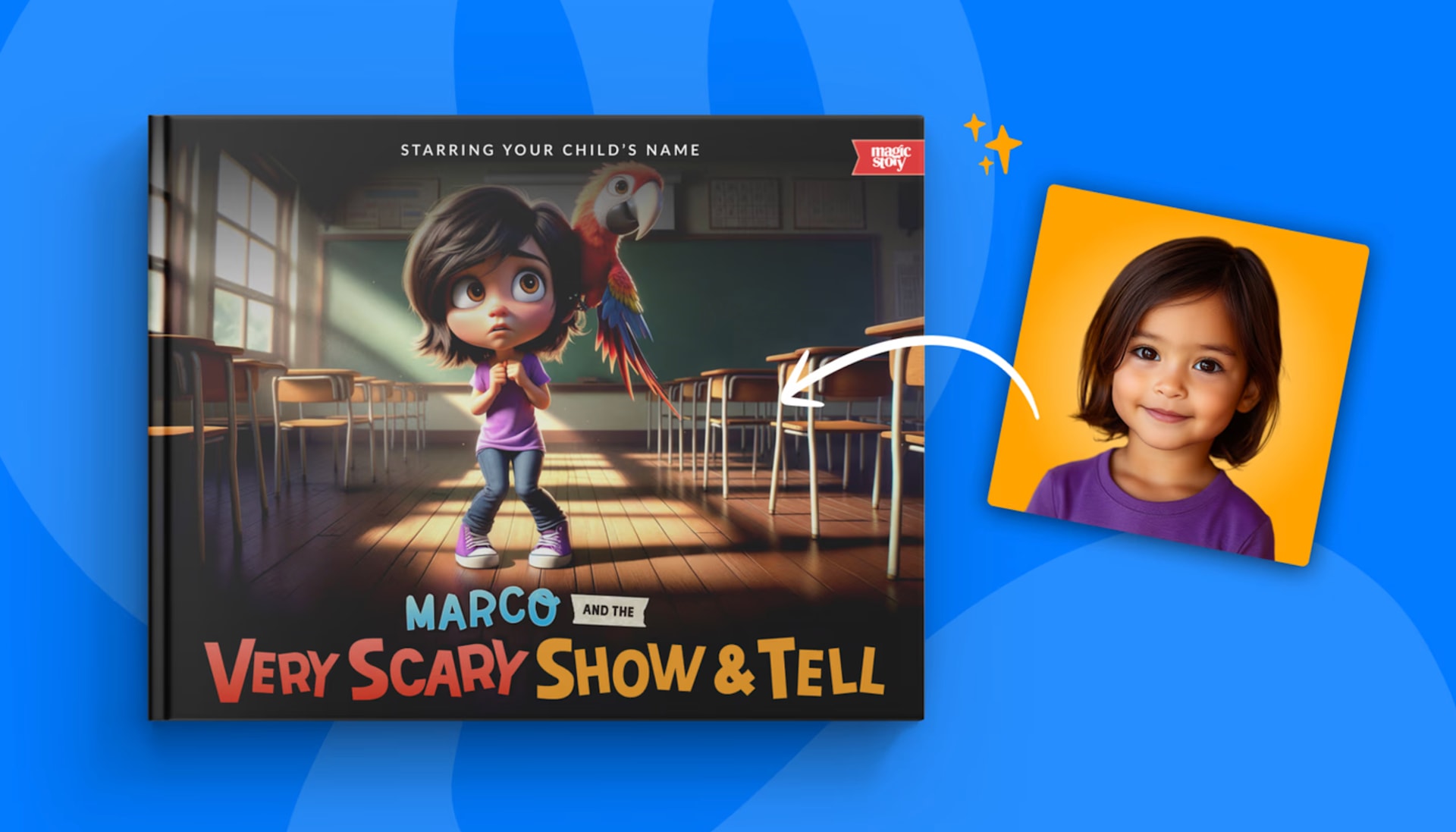
Magic Story uses a child's photo to create a recognizable illustrated hero who appears throughout a cinematic story. Books are available as hardcovers, and Magic Story+ continues the child's library with a new personalized story each month that the adult can review and swap before it ships.
Is it too late to give a personalized book if my child already started kindergarten?
Not at all. Whether your child is about to start or already settled in, books that acknowledge the reality of this transition — both the excitement and the nerves — are valuable throughout the kindergarten year. Five-year-olds are processing big changes for months, not days, and stories that show school as big but manageable keep reinforcing confidence. A personalized book where your child is the capable, brave hero stays meaningful long after the first day.
Are personalized books worth it when my child already gets books from school and the library?
They serve a different purpose. Library books open a wide world of characters and ideas; a personalized book lets your child recognize themselves as the hero throughout one story. Magic Story titles center real moments such as naming anger, telling the truth, asking a curious question, or taking a brave next step. See the current product page for pricing.