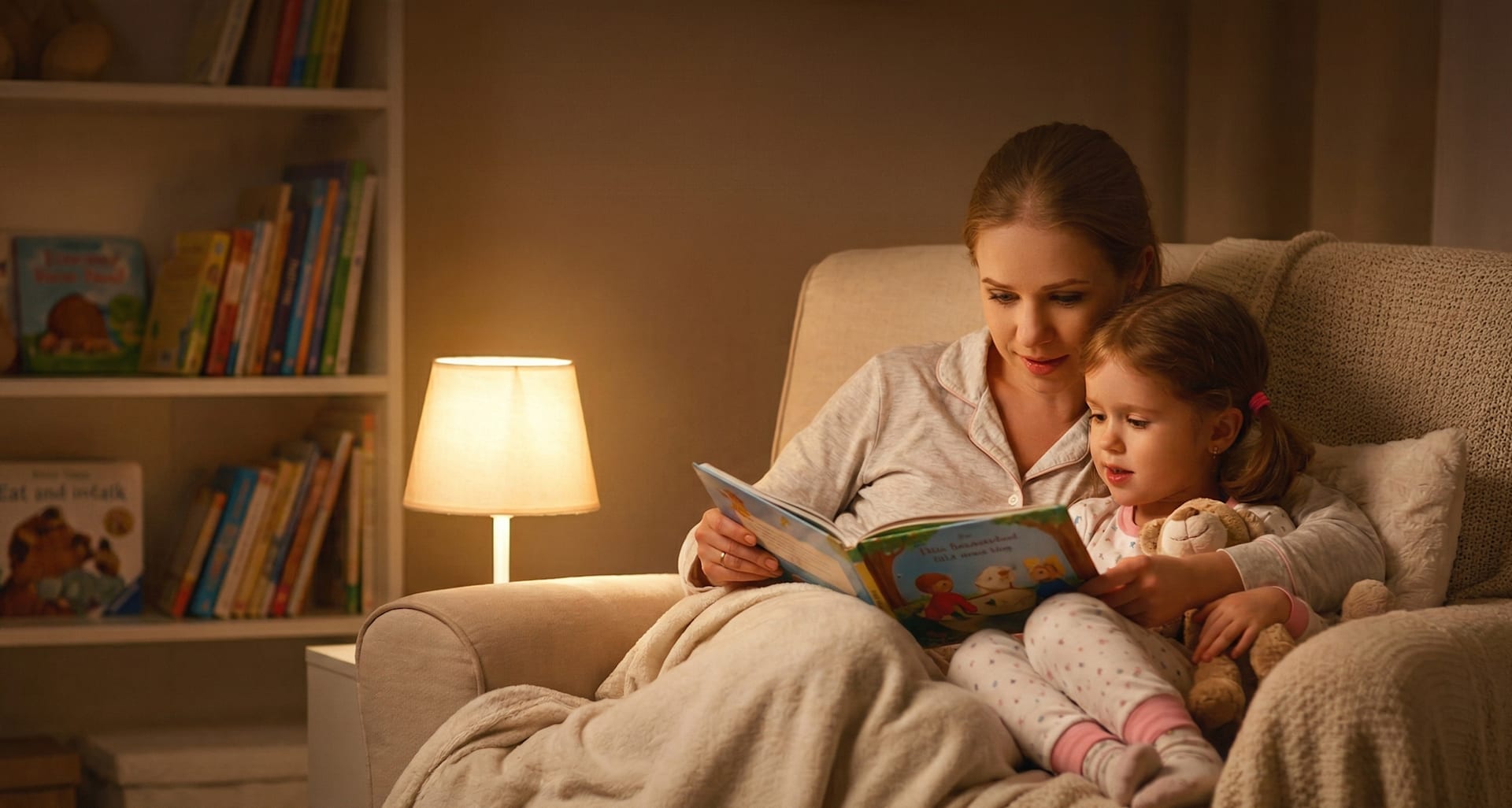
Bedtime Stories for Kids: Why They Matter More Than You Think
Discover the science behind bedtime stories for kids. Learn how reading before bed rewires your child's brain, improves sleep, and builds emotional connection.

10 min read | February 16, 2026 · Updated May 31, 2026

Renata rushed through her evening - dishes, laundry, emails - when she finally tucked three-year-old Marcus into bed. She grabbed a picture book and started reading in a tired monotone, already thinking about everything else on her to-do list. But then something shifted. Marcus's breathing slowed, his little hand reached for hers, and by the end of the first story, he was completely still - eyes heavy, shoulders relaxed.

That's when it hit her: bedtime stories weren't just about getting him to sleep. They were doing something deeper.
If you're a parent, you've probably sensed this too. There's something almost magical about those quiet moments before bedtime - something that feels more important than just knocking items off a checklist. But what if I told you that instinct is backed by solid science? What if those bedtime stories you're reading are literally rewiring your child's brain, improving their sleep quality, and building a foundation for academic success?
This is what you need to know about bedtime stories for kids, and why making this simple ritual a priority might be one of the best decisions you make as a parent.
What Does the Research Actually Say About Bedtime Stories?
Bedtime stories for kids aren't just a cute tradition — research links early, consistent reading to measurable gains in vocabulary and reading skills years later, plus stronger working memory, attention, and language development in children whose families read regularly at bedtime.
Research presented at the 2017 Pediatric Academic Societies Meeting found that the quality and quantity of shared book-reading in early infancy and toddlerhood predicted children's vocabulary up to four years later, before they even started school. Separate brain-imaging research on shared reading and preschoolers has found that children whose home environment includes more reading show measurably different activation in language-processing regions of the brain — early evidence that consistent reading is associated with how a young brain is wired for language.
Research on preschoolers' bedtime routines has also linked language-based routines like reading to longer, better-quality sleep, along with gains in the skills that affect how your child learns, thinks, and solves problems:
| Skill | What the research links to bedtime reading routines |
|---|---|
| Working memory | Stronger recall and mental holding of information |
| Attention span | Longer sustained focus |
| Impulse control | Better ability to pause before reacting |
| Language development | Faster vocabulary and syntax growth |
| Cognitive flexibility | Easier shifting between ideas and tasks |
These aren't small upgrades. They're foundational skills that shape how your child learns and solves problems for years to come.
How Do Bedtime Stories Improve Sleep Quality?
Bedtime stories work like a neurological off-ramp from the day: reading slows your heart rate, deepens breathing, and activates the parasympathetic nervous system, your body's "rest and digest" mode, which is why a wound-up kid tends to settle during a story in a way they won't during quiet lying-in-the-dark time alone.
The Stress Reduction Effect
Research on adults suggests that even a few minutes of quiet reading can measurably relax the body — slower heart rate, looser muscles, and other markers of reduced stress. Children, who have even less capacity than adults to self-soothe racing thoughts, likely benefit from a similar calming mechanism, though most of this research has focused on adult readers rather than children.
Better Sleep, Actually
Longitudinal research on preschoolers' bedtime routines has found that language-based routines, including reading, are associated with longer total nighttime sleep, and separate research on bedtime routines more broadly shows a dose-dependent relationship: more consistent routines track with better sleep outcomes. Many parents report that reading also helps them fall asleep faster themselves once their child is settled.
The Blue Light Factor
Unlike screens, physical books don't emit blue light that suppresses melatonin production. Melatonin is crucial for regulating your child's sleep-wake cycle. When you swap screen time for a bedtime story, you're actively supporting your child's natural sleep biology.
Routine as a Signal
Your child's brain is incredibly smart. When bedtime stories become a consistent part of the routine - the same time, the same calm voice, the same quiet space - their brain learns to interpret this as a signal: "Sleep is coming." This predictability is soothing. Predictability is powerful.
How Do Bedtime Stories Build Language and Literacy Skills?
Bedtime stories build vocabulary and literacy skills because every word your child hears in a story is delivered in a meaningful, emotionally engaging context — which research shows builds more robust language skills than words encountered any other way, and predicts reading ability years later.
Every story your child listens to teaches them how language works: syntax, narrative structure, cause-and-effect. When you read aloud, your child isn't just passively absorbing; their brain is actively engaging with complex linguistic patterns. Babies who are read to regularly from infancy show meaningfully faster growth in receptive vocabulary, the words they understand, than babies who aren't. The American Academy of Pediatrics recommends reading aloud starting from birth precisely because of how early this language advantage compounds.
This early language boost matters because vocabulary in the second year of life is a strong predictor of reading ability at age six, and reading ability at age six is one of the strongest predictors of academic success in elementary school. By making bedtime stories a priority when your child is young, you're giving them a head start that compounds year after year.
How Do Bedtime Stories Support Emotional Regulation?
Bedtime stories create a safe, intimate space for emotional connection that no app or educational video can replicate — and that safety is what allows a child's nervous system to genuinely relax at the end of the day.
Children experience big emotions. Sometimes they're anxious about starting school, frustrated about limits, or confused about changes in their world. Stories are a way to explore these feelings indirectly. A character in a story might face fear, sadness, or conflict, and your child gets to witness how they work through it in a controlled, safe environment.
This is also why the presence matters so much. It's not just about the words on the page. It's your warm voice, your undivided attention, your physical closeness. These elements signal safety, and safety is what allows your child's nervous system to truly relax.
When your child associates bedtime with this kind of calm, attentive connection, they internalize a profound message: I am loved. I am safe. I can rest.
That foundation of security affects far more than just their sleep. It affects their ability to manage stress, build relationships, and face challenges with resilience — one of several reasons bedtime story routines strengthen bonds well beyond the nursery years.
How Do You Build a Bedtime Reading Routine That Actually Sticks?
Here's the thing about bedtime stories: they're only powerful if they're consistent. One story on a random Tuesday doesn't create the neural rewiring or the routine signal that makes this practice so transformative. For a step-by-step framework, see our guide to a bedtime reading routine kids love.
Start Small and Anchor It to Something You Already Do
Don't aim for 30 minutes if your family is chaotic and rushed. Start with 10 minutes, one or two books, attached to a routine you already have - after bath time, before teeth brushing, whatever fits your family's flow. Consistency matters more than duration.
Create a Physical Transition
Bedtime stories work best when they're the last thing before sleep. This means no jumping back up for water, no turning on the light again. Your child's brain needs to understand: stories = sleep is next.
Some families create a special reading spot - a particular chair, a cozy corner, a specific blanket. This ritual cue helps your child's brain recognize what's coming.
Choose Age-Appropriate Books
| Age | Suggested length | What works best |
|---|---|---|
| Toddlers (1-3) | 5-10 minutes | Simple, repetitive language; board books |
| Preschoolers (3-5) | 10-15 minutes | Slightly more complex plots and gentle themes |
| Early elementary (5-8) | 15-20 minutes | Engaging narratives, more developed characters |
| Older kids | 20-30 minutes | Chapter books, longer arcs |
Listen to your child over the chart: if they're drowsy and content, the length is working; if they're restless, go shorter and more engaging.
Pay Attention to Story Tone
Exciting, action-packed stories might keep your child's adrenaline up. Look for books with calm tones, gentle pacing, and soothing language. This is where stories with themes of mindfulness and emotional calm can be especially powerful.
Make It Interactive (But Gently)
Ask soft questions: "What do you think will happen next?" "How do you think the character is feeling?" But don't turn it into a quiz — these interactive story-time tips work best kept conversational and low-pressure.
Set Boundaries Kindly, and Let Your Child Choose Sometimes
Kids will always want "one more story." This is normal. Being clear about limits ("We're reading two books tonight, then it's sleep time") is kind, not cruel - it teaches your child that predictability and boundaries are safe. Within those limits, giving your child some agency ("Which two books do you want tonight?") increases their buy-in and investment in the routine.
Don't Stress About "Perfect" Reading
Your child doesn't need dramatic, theatrical reading. They need your presence and your calm voice. Tired, quiet reading is absolutely fine. In fact, sometimes it's perfect. And if you miss a night, just start again tomorrow - routines break sometimes, life happens, and one missed night doesn't undo weeks of benefits.
Extend Stories Beyond Bedtime (Optional)
Some families enjoy reading together at other times too - after lunch, while waiting, during car rides. More reading = more benefits, but bedtime stories are the essential foundation.
Does the Book Itself Matter, or Just the Ritual?
Mostly the ritual, but tone still matters at bedtime. Finding books built for wind-down rather than excitement can make the routine easier to sustain, especially for kids who struggle with racing thoughts or big feelings at bedtime. Zen & the Storm Inside, a personalized story built around mindfulness and emotional awareness, is one example of a book designed specifically for that calm, bedtime-appropriate pace rather than excitement or conflict.
Whatever books you choose, what matters most is the act of reading together, night after night, in whatever voice feels natural to you.
Start Tonight
If you've been thinking about adding bedtime stories to your routine but haven't gotten around to it, tonight is a good night to start, not next week. Grab one book, sit with your child, and read in whatever voice feels natural. Notice how their breathing changes, how their body relaxes, how they settle into the moment.
You're not just reading words on a page. You're signaling safety, building neural pathways that will support learning for years, and creating a memory, that specific warmth and closeness, that your child will carry forward.
Renata didn't set out to change Marcus's brain that first tired evening; she just wanted him to fall asleep so she could finish the dishes. But that's the real power of bedtime stories for kids: the science is happening whether or not you're thinking about it, every time you show up, sit down, and read. It's simple, it's inexpensive, and it works.
Frequently Asked Questions
Is it ever too early to start reading bedtime stories?
No. The American Academy of Pediatrics recommends reading to children from birth. Even newborns benefit from hearing your voice and experiencing closeness, and at 4-6 months babies start to show interest in looking at books. The earlier you start, the more likely the habit will stick.
What if my child won't sit still for stories?
This is incredibly common — some kids are naturally more active or have shorter attention spans. Start with just 5 minutes, choose high-interest, visually engaging books with fewer words, and don't force a rigid structure. Some families read while the child lies in bed, which feels less structured. The goal is consistency, not perfection.
Should I read the same book over and over, or mix it up?
Both are valuable. Repetition is comforting for children and allows deeper learning — they pick up new details and language patterns with each read. Variety keeps things fresh for parents and exposes children to different stories and language. A mix of both works best.
How long should bedtime stories actually last?
Age is a rough guide: toddlers (1-3) about 5-10 minutes, preschoolers (3-5) about 10-15 minutes, early elementary (5-8) about 15-20 minutes, and older kids 20-30 minutes. But listen to your child — if they're drowsy and content, that's the right length; if they're restless, try shorter, more engaging books.
What if screens are already part of our bedtime routine?
You don't need a dramatic overnight change. Consider a gradual shift: screens at 7:30, stories at 7:50, then sleep. Even adding one story per night is a step forward. Research is clear that physical books have neurological advantages over screens, but even partial replacement has benefits.
How do I know if bedtime stories are actually working?
Look for signs over weeks, not days: is your child falling asleep more easily, sleeping longer, calmer at bedtime, more rested during the day, or having fewer nightmares? Also watch for language development — increased vocabulary and more complex sentences. These changes take time to become obvious, but they do show up.